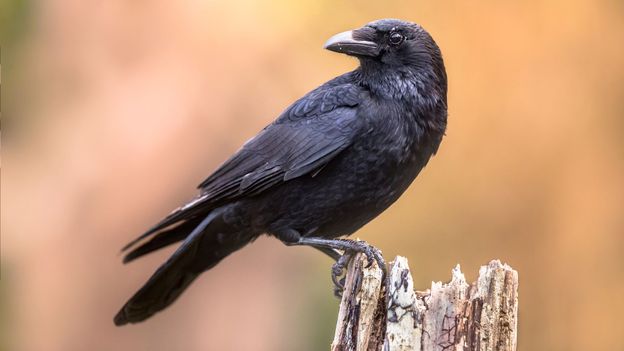
Science Crows could be the smartest animal other than primates - Crows have long been considered cunning. But their intelligence may be far more advanced than we ever thought possible.


1576148828683.png


The crow’s name was Betty. And she was on her way to stardom. A gaggle of Oxford University scientists watched in wonder as she casually picked up a piece of wire in her cage and then used a nearby object to bend it at one end, transforming the wire into a hooked tool. That tool allowed Betty to hoist up a small container of meat – delicious pig’s heart – from inside a plastic tube. Lunch was served.

Back then, in 2002, Betty’s feat was a source of amazement. How did this crow solve such a complex problem so spontaneously? It suggested mental acrobatics akin to our own. This, the headlines read, was one stunningly clever crow.

Except that Betty was not quite as special as some first thought. Many years later, research showed that New Caledonian crows are habitual tool-benders. In the wild, they do it all the time. Observers had initially been startled by Betty’s behaviour because it looked as though she had come up with the design for her hooked tool on the fly. Like an engineer inventing a new machine. In reality, New Caledonians have evolved to make hooked tools from soft twigs as part of their usual foraging activity.

It was less a moment of genius – and more an expression of her nature.

“I don’t want to downplay her cognitive abilities,” says Christian Rutz at the University of St Andrews. “At the very least, it forces us to reassess how insightful Betty’s behaviour was.”

New Caledonian crows belong to the corvid family of birds – as do jackdaws, rooks, jays, magpies and ravens. In recent years, the brains of these birds have been studied ever more closely. There is no doubt that some of them display impressive cognitive abilities. But intelligence is a murky subject. What exactly is it, in the first place? And why has it evolved?

Corvids are helping us to answer these questions.

1576148876357.png

The New Caledonian crow uses twigs and branches to extricate grubs and insects from inside trees.

Intelligence is rooted in the brain. Clever primates – including humans – have a particular structure in their brains called the neocortex. It is thought that this helps to make advanced cognition possible. Corvids, notably, do not have this structure. They have instead evolved densely packed clusters of neurons that afford them similar mental prowess.

The specific kind of brain they have doesn’t really matter – corvids and primates share some of the same basic capabilities in terms of problem-solving and plasticity, or being able to adapt and change in the face of new information and experiences. This is an example of convergent evolution, where completely different evolutionary histories have led to the same feature or behaviour.

It’s easy for humans to see why the things corvids can do are useful. From identifying people who have previously posed a threat to them or others in their group to using gestures for communication – we too rely on abilities like these.

Rutz is unequivocal. Some birds, like the New Caledonian crows he studies – can do remarkable things. In a paper published earlier this year, he and his co-authors described how New Caledonians seek out a specific type of plant stem from which to make their hooked tools. Experiments showed that crows found the stems they desired even when they had been disguised with leaves from a different plant species. This suggested that the birds were selecting a kind of material for their tools that they knew was just right for the job. You wouldn’t use a spanner to hammer in a nail, would you?

Ranking the intelligence of animals seems an increasingly pointless exercise when one considers the really important thing: how well that animal is adapted to its niche
In the wild, New Caledonians use their tools to scoop insects out of holes, for example in tree trunks. Footage of this behaviour has been caught on camera.

You might think that some animals are smarter than others – with humans at the top of the proverbial tree. Certainly, humans do rely excessively on intelligence to get by. But that doesn’t mean we’re the best at every mental task. Chimps, notes Dakota McCoy at Harvard University, have been shown to possess better short-term memories than humans. This might help them to memorise where food is located in the forest canopy, for example.

Ranking the intelligence of animals seems an increasingly pointless exercise when one considers the really important thing: how well that animal is adapted to its niche. Intelligence is, first and foremost, a means towards specialisation.

As Rutz says, analysis of crows’ intelligence “cannot be divorced from the natural history of the animal”. And New Caledonians are far from the only non-human species to have evolved the ability to use tools. The list of other animals that share this trait includes chimpanzees, parrots, alligators and even crabs.

1576148900235.png

Crows and ravens have a natural curiosity, research suggest.

While cognition may help a creature to do things required for survival in its own environment, other animals get by via other means. Where a crow uses mental abilities and tools to access hard-to-reach food, a giraffe simply stretches its long neck. Clever cogs just have another tool from evolution’s own toolbox.

That said, “clever” animals can sometimes perform tasks beyond those strictly demanded by nature.

In this clip from the BBC TV series, Inside the Animal Mind, Chris Packham watches a New Caledonian, nicknamed 007, solve an artificially constructed puzzle involving eight distinct steps.

This seems to dwarf Betty’s humble hooked tool demo. A crow has now been shown to apply its cognitive abilities to advanced problem solving. It’s a situation the bird would never encounter in the wild, but it excels all the same. True, 007 had already learned how the individual steps worked but solving them in sequence presents an even greater challenge. It’s a hint that this bird can plan ahead to some extent. There are likely many other fascinating things that 007 and his fellow crows can do, we just haven’t tested for them yet.

McCoy, like Rutz, also studies New Caledonian crows. In a paper published this year, she and colleagues described an experiment designed to show if the birds’ mood were affected by tool use. New Caledonians were trained to recognise that a box at one end of a table contained more food than a box at the opposite end. Then, the crows were presented with a box in the middle of the table – suggesting an uncertain quantity of meat inside.

Birds that had recently used tools to retrieve food from a container approached the mystery box more quickly than those that had not used tools. This indicated that tool use made the crows more optimistic, says McCoy.

That’s not to say they were necessarily “happy”, she adds – but it does suggest a positive relationship between tool use and expectation.

Cognition, says McCoy, can be fun. It opens a door to behaviour that isn’t necessarily essential for survival.

1576148963877.png

Crows have shown advanced problem solving for situations they would never encounter in the wild.

Crows, in fact, might be like us not so much because they are clever (and so are we) but rather because they sometimes engage their cleverness simply for fun – and so do we.

The crows McCoy studies have a natural curiosity, she says. They cheekily grab scientific equipment and fly off with it in the aviary. Young birds especially, she says, love to play. Humans are not so different, she argues: “We have these incredibly huge brains but we use them to do crossword puzzles – that’s not something that is evolutionarily selected for.”

One could argue that there are utilitarian benefits to such mental exertion. It keeps the mind sharp, it reinforces one’s abilities – all the fitter to survive. But if there is pleasure in it or if it has unexpected effects, one might also say that such activity is just part of what makes life colourful. New Caledonian crows, like us and other clever animals, have moods and memories. Strategies and expectations. They seem remarkably able to engage with complexity.

Evolution made this possible. But cognition, like life itself, serves more than just a need. Animal intelligence allows all sorts of fascinating phenomena to arise. A gorilla that recognises human language. A crow that solves puzzles. A parrot that tells jokes.

Nature provided the notes, but animal brains make the music. The mind, as they say, is the only limit.

---


Very nice. I've never even seen a crow in my city, they are such cool birds.

Thread music, because why the hell not:

 
"New Caledonians are far from the only non-human species to have evolved the ability to use tools..."
Wait a second-

Never seen European nor American crows, but I'm fairly certain Australian crows are starting to learn from the bin chickens. I've observed them opening the lids of bins in a similar manner to the Ibises. They're fairly intelligent.

It's only a matter of time until one of them figures out how to start a fire, if they haven't already.
 
It fascinates me how intelligence can be arrived at and in different ways. The concept of evolutionary dead-ends also fascinates me: The idea that a species can be better at something than another but that their path is closed and another open-ended. I'd love to be a brilliant genetic scientist without constraint trying to get other species out these traps and see how they could progress with those obstacles removed. For example, octopuses are notoriously clever but they don't live long. They breed and then die. I would love to solve that for them somehow and see what you got with an octopus that could breed repeatedly and lived decades. Would they become social, would they become even smarter and learn more sophisticated concepts? Or crows - they don't have a neo-cortex like us. They've found a different brain structure that also lets them be smart. One that, if I read it correctly, is more distributed than centralised. But they are tiny. What if you could make a three foot tall crow with proportionately the same brain size? Would it be even smarter? If we started selectively breeding for intelligence on a large scale, how smart could we make them and could we get them over their current hurdle? Of course to them it's not a hurdle - they're adapted to the level of resource in their environment. But what if we could make one that was more? I'd love to know how its way of thinking would differ from our own. Would it have the same sense of self if it were as smart?

This reminds me of the novella "Blindsight" by the marine biologist Peter Watts. The only vampire novel written that is actually scary. (For the love of all that is Holy, avoid spoilers for this novella and read it fresh, if you're inclined to look it up). How many ways are there to be smart?
 
Crows are fucking based. There's videos out there of crows using plastic container lids like snowboards or sleds to slide down snow covered rooftops, and then flying back up to the top of the roof to do it again.

Crows can also recognize specific people, even if those people cover their face with a mask, AND communicate those people's appearance to their offspring, all seemingly without a comprehensible language that we can understand.
 
yeah but who would win in a 1v1 a crowstorm of one single chimpanzee
science dosent even know the true strength potential of one gorilla how the fuck am i supposed to believe these faggots typing about "intelligence" when nobody knows how strong one single big ape is
let alone the strength of one single crow
 
Crows are smart as fuck and also good bros. As a bird feeding loner, I have had the privilege to have a few crowbros over the years and they absolutely do recognise you as the soft touch with a reliable food source. After a while, they will sit beside you and eat once they've worked out you're not going to do anything to them.

This summer, there was a young magpie born in my big conifer hedge. Magpies are territorial, and the young ones spend most of their first winter in their parents' territory, so this young crowbro spends a lot of time tucked in the porch of my kids' playhouse. I fed his parents over the summer when they were nesting, so they aren't much concerned about me. They taught him to fly in my back garden and he was hilariously bad at it at first. Many headfirst plunges were taken from the top of the swing set.

He's learnt to play with the dog - he will take her little tennis ball and drop it and then sit on the swings caw caw caw'ing at her. He greets me in the morning. I feed him each day and on the big feeding table/pole/holder thing I have, I put a bunch of bird toys for him. I see him each day out there having a wee play to himself.

I hope some bastard fox doesn't eat him.
 
yeah but who would win in a 1v1 a crowstorm of one single chimpanzee

Crows have no external testicles to rip off so that's the chimpanzee's go-to power move already rendered null and void. Frankly, chimps are optimized for one to one combat. Whilst a chimp has devastating damage potential it's delivered singularly. A chimp cannot kill a crow so hard that other nearby crows spontaneously die with it. Whilst the chimp kills one, it suffers a dozen other attacks including at its face. The chimp cannot both cover its face and strike back so if the corvids are going full Hitchcock on it, I'm going to heavily favour the crowstorm.
 
The two unverified crow stories I've read elsewhere I liked were:
• a man made a birdseed vending machine and taught crows how to use it. Crows began seeking out loose change on the streets to buy food from his machines and he apparently made $50-$75 a week from his flying busybodies
• some guy on 4chan became aware of two different flocks of crows by his factory job. He intentionally fucked with one, throwing rocks and garbage at one, and bringing food regularly to the other. At one point he tricked some of the mad enemy crows into following him/harrassing him in front of the crows he fed, and the fed friendly crows went to war with the angry crows to defend him.
 
Terrible news for women this week, as they slip further behind the top ten
A few more years like this and they could find themselves relegated to the plant leagues

The two unverified crow stories I've read elsewhere I liked were:
• a man made a birdseed vending machine and taught crows how to use it. Crows began seeking out loose change on the streets to buy food from his machines and he apparently made $50-$75 a week from his flying busybodies
• some guy on 4chan became aware of two different flocks of crows by his factory job. He intentionally fucked with one, throwing rocks and garbage at one, and bringing food regularly to the other. At one point he tricked some of the mad enemy crows into following him/harrassing him in front of the crows he fed, and the fed friendly crows went to war with the angry crows to defend him.


Researchers did a thing where they went and harassed local crows while wearing masks, when they walked through the park afterwards wearing the same masks, the crows would dive bomb them to drive them off, when they wore no masks or different masks the crows left them alone. This effect was seen generations after the original crows died out by crows that had never experienced the initial event.
The question remains, if you post in this thread dissing crows could a crow that read it dox you and start a family blood fued lasting generations?
 
The intelligence of animals is always a fascinating field because one thing that makes it so difficult to measure is you can't easily know how tractable any given species is. Everyone knows parrots can talk but not many people know corvids can also talk - because corvids have a different attitude and they're not as amenable to training. The abilities of an animal go unrecognized if that animal is just not particularly willing to show them off.

Crows have no external testicles to rip off so that's the chimpanzee's go-to power move already rendered null and void. Frankly, chimps are optimized for one to one combat. Whilst a chimp has devastating damage potential it's delivered singularly. A chimp cannot kill a crow so hard that other nearby crows spontaneously die with it. Whilst the chimp kills one, it suffers a dozen other attacks including at its face. The chimp cannot both cover its face and strike back so if the corvids are going full Hitchcock on it, I'm going to heavily favour the crowstorm.
David Attenborough narrates "Bum Fights: Nature Edition."
 
Crows (and all birds, really) are forever cucked by the fact that they gave up the potential for fine manipulators in favor of flight. Like, yes, they have roughly hand-shaped claws that can grasp objects, but using their feet to manipulate objects cuts their mobility. I think the main reason humans succeeded is a combination of our large brains, and our ability to easily manipulate our environment.

I still think octopuses have the best shot at inheriting the earth, they just have to evolve past the whole “dying after giving birth” and “can’t live on land” thing. That’s nothing a couple tens of millions of years of evolution can’t fix.
 
Atrás
Top Abajo