Trump Administration Requires Drug Testing for Food Stamp Recipients

  • 🇵🇦 Nuestro primer dominio localizado está en español en kiwifarms.pa. Our first localized domain is on Spanish on kiwifarms.pa.
  • Want to keep track of this thread?
    Accounts can bookmark posts, watch threads for updates, and jump back to where you stopped reading.
    Create account
be727e1ffa804e435fe842c4134cf948.png

WASHINGTON (AP) — The Trump administration is considering a plan that would allow states to require certain food stamp recipients to undergo drug testing, handing a win to conservatives who’ve long sought ways to curb the safety net program.

The proposal under review would be narrowly targeted, applying mostly to people who are able-bodied, without dependents and applying for some specialized jobs, according to an administration official briefed on the plan. The official, who spoke on condition of anonymity to discuss internal deliberations, said roughly 5 percent of participants in the Supplemental Nutrition Assistance Program could be affected.

The drug testing proposal is another step in the Trump administration’s push to allow states more flexibility in how they implement federal programs that serve the poor, unemployed or uninsured. It also wants to allow states to tighten work requirements for food stamp recipients and has found support among GOP governors who argue greater state control saves money and reduces dependency.

Internal emails obtained by The Associated Press indicated that Agriculture Department officials in February were awaiting word from the White House about the timing of a possible drug testing announcement.

“I think we just have to be ready because my guess is we may get an hour’s notice instead of a day’s notice,” wrote Jessica Shahin, associate administrator of SNAP.

Conservative policymakers have pushed for years to tie food assistance programs to drug testing.

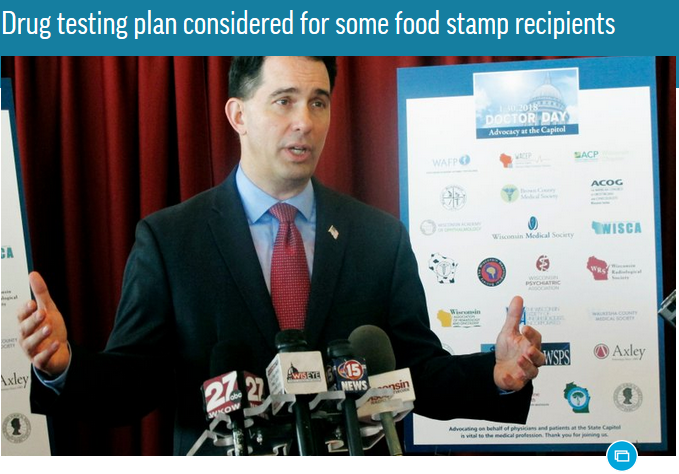
Wisconsin Gov. Scott Walker, a Republican, sued the USDA in 2015 for blocking the state from drug testing adults applying for food stamps.
800.jpeg

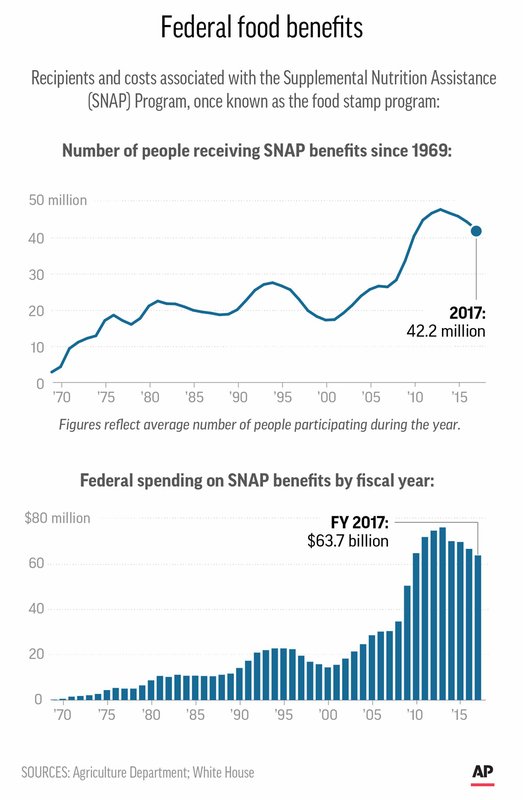
Chart shows federal SNAP/food stamp participation and spending since 1969.

A federal judge tossed the suit in 2016, but Walker renewed his request for permission later that year, after Donald Trump had won the presidency but before he took office.

“We turned that down,” said former USDA Food and Nutrition Service Undersecretary Kevin Concannon, who served in the position under the Obama administration from 2009 until January of last year. “It’s costly and cumbersome.”

The proposal is not expected to be included in a GOP-written farm bill expected to be released as soon as early this week, a GOP aide said.

Federal law bars states from imposing their own conditions on food stamp eligibility.

Still, some states have tried to implement some form of drug testing for the food assistance program, so far with little success.

Judges have blocked similar efforts in other states. In Florida in 2014, a federal appeals court upheld a lower court’s ruling that drug testing SNAP recipients is unconstitutional.

But at least 20 states have introduced legislation to screen safety net program participants in some capacity, according to the National Conference of State Legislatures.

In December, Walker began moving ahead with a workaround, drug testing participants in the state’s Employment and Training Program who also received food stamps.

USDA under Trump has not taken a public position on drug testing. But Secretary Sonny Perdue has promised to provide states with “greater control over SNAP.”

“As a former governor, I know first-hand how important it is for states to be given flexibility to achieve the desired goal of self-sufficiency for people,” he said. “We want to provide the nutrition people need, but we also want to help them transition from government programs, back to work, and into lives of independence.”

The emails obtained by the AP suggest that a plan could be forthcoming.

The plan would apply to able-bodied people who do not have dependents and are applying for certain jobs, such as operating heavy machinery, the official said.

In a February 15 email to USDA officials, Maggie Lyons, chief of staff to an acting official at the Food and Nutrition Service, said, “We need to have a conversation about timing given budget and when the (White House) wants us to release drug testing.”

If the administration moves forward, it would not be the first time drug testing was used in a safety net program.

At least 15 states have passed laws allowing them to drug-test recipients of Temporary Assistance for Needy Families, also known as welfare.

The discussion of the future of SNAP and potential changes to the program are set against the backdrop of the 2018 farm bill, slated for release as soon as this week. The bulk of the bill’s spending goes toward funding SNAP, which often proves the most contentious part of negotiations; late last month, House Agriculture Committee Ranking Member Collin Peterson, D-Minn., issued a statement on behalf of Democrats denouncing “extreme, partisan policies being advocated by the majority.”

Ed Bolen, senior policy analyst at the Center for Budget and Policy Priorities think tank, said requiring drug testing for food benefits will have consequences for already vulnerable populations. What’s more, he said, implementing drug testing for SNAP recipients is legally murky.

“Are people losing their food assistance if they don’t take the test, and in that case, is that a condition of eligibility, which the states aren’t allowed to impose?” he said. “And does drug testing fall into what’s allowable under a state training and employment program, which typically lists things like job search or education or on-the-job experience? This is kind of a different bucket.”

The emails also show that USDA is weighing the possibility of scaling back a policy currently enacted in 42 states that automatically grants food stamp eligibility to households that qualify for non-cash assistance, like job training and childcare. The proposed change, which would impose income limits, could potentially affect millions.

Republicans tried to make similar changes when Congress passed the 2014 farm bill, but the cuts were rejected by Democrats and did not end up in the final bill.

Concannon, the former USDA undersecretary, said the Trump administration “is keen on weakening the programs developed to strengthen the health or fairness or access to programs and imposing populist requirements that aren’t evidence based, but often stigmatize people.”

The USDA in recent months has been under fire for its controversial plan to replace a portion of millions of food stamp recipients’ benefits with a pre-assembled package of shelf-stable goods dubbed “America’s Harvest Box.” The food box plan was tucked into the Trump administration’s proposed 2019 budget, which included cutting the SNAP program by $213 billion over the next 10 years. SNAP provides food assistance to roughly 42 million Americans
Full Article | Archive

I can hear Detroit and California and Florida screaming from here, already. How long have we been waiting for a policy like this to get thrown into the mix now, two decades? Three? I honestly can't remember but it's about goddamn time that it's starting to be seriously floated around.

This ties in fantastically to the Executive Order he signed yesterday, too. There's an all-out war headed towards the NEETs and the illegal immigrants and drug addicts saddled up on welfare, so you'd best buckle your seatbelts because that's going to affect a lot of the people we follow on this forum.
 
Snopes is actually an excellent source of unbaised, well-researched information. That's not really disputed by anyone.

The best argument people have against snopes is that their ultimate judgement, the "rating" they issue, is biased as fuck. It's used as an excuse to ree against Snopes, but it doesn't really say anything about the quality of their research itself.
"Snopes isn't biased, but they do this one thing that's incredibly biased."

That's literally all that anyone ever uses it for, though. If they took out that utterly ridiculous rating system I'd almost be more-inclined to believe it, but 100% of every discussion I've ever held with anyone who cites something from Snopes boils down to, "See it's FALSE, look!" and then the actual research they've conducted underneath the post itself works to paint a picture that's a polar opposite of the rating they gave the story in the first place. They never cite the actual research, they just jam their fingers at that moronic sticker and scream about how wrong you are.

You're genuinely better off just conducting your own research on a topic. Expecting one, lone outlet to correlate all the requisite information and do so without any bias whatsoever on the part of the author(s) is just asking for trouble. I'm also particular hesitant to trust an organization that has had PolitiFacts, Facebook, The NYT, the Huffington Post, the Washington Post, and FactCheck.org repeatedly running to its defense to scream about how unbiased and "totally fair" the organization is. That looks shifty.
 
Última edición:
Our Governor of Florida, Rick Scott was supposed to this for welfare recipients, but it never happened...

Once again, Trump is getting shit done.


If it actually happens. Western nations talk about doing this all the time and it ends up going nowhere because the cost would be greater than the potential savings and too many legitimate recipients would be disadvantaged by it. It's a feel good proposal, nothing more.
 
If it actually happens. Western nations talk about doing this all the time and it ends up going nowhere because the cost would be greater than the potential savings and too many legitimate recipients would be disadvantaged by it. It's a feel good proposal, nothing more.
The federal government isn't mandating it. It's basically to allow states who don't have retarded activist judges to allow it.
 
The federal government isn't mandating it. It's basically to allow states who don't have exceptional activist judges to allow it.
As it should be, the biggest advantage to having states is to test potential major changes to legislation before implementing it federally.

Let Florida, Texas, Alabama or wherever wants to implement these programs on their population and see if it actually produces results in terms of curbing welfare fraud compared to the expenditure that drug testing is going to require up front. I'm skeptical it'll do much to actually reduce fraud and consider this mostly pandering legislation but I'm happy to be proven wrong.
 
As it should be, the biggest advantage to having states is to test potential major changes to legislation before implementing it federally.

Let Florida, Texas, Alabama or wherever wants to implement these programs on their population and see if it actually produces results in terms of curbing welfare fraud compared to the expenditure that drug testing is going to require up front. I'm skeptical it'll do much to actually reduce fraud and consider this mostly pandering legislation but I'm happy to be proven wrong.

If it's not going to apply federally, why wouldn't people just move states to bypass it? Or is the amount of monthly assistance not worth the bother?
 
I know that in California, you can buy a wedding cake with food stamps.
That bullshit needs to stop.

I've always felt that food stamps should be like WIC, you're only allowed to buy certain foods in certain sizes.

At least people wouldn't be buying 7-11 pizzas and wedding cakes.
I've been a cashier and can tell some stories about what people buy with stamps.
 
If it's not going to apply federally, why wouldn't people just move states to bypass it? Or is the amount of monthly assistance not worth the bother?
Isn't it strange, people can just up and move where welfare is more money and drugs have looser laws?

I thought they were one step away from deaths door and homelessness. Really makes you think.
 
I've been a cashier and can tell some stories about what people buy with stamps.
Please do, that sounds fascinating.

I've never gotten over the fact that one of the stores I frequent has these huge, elaborate platters that are nothing but high-shelf foodstuffs like name-brand goat cheese and almonds and cashews and all sorts of designer meats, and then right smack on the top of the packaging is this enormous, "Eligible for EBT!" sticker. That platter costs like $25 and there's not even that much food in it. Why the fuck is it eligible for that?
 
Última edición:
If it's not going to apply federally, why wouldn't people just move states to bypass it? Or is the amount of monthly assistance not worth the bother?

Moving isn't cheap, and most people who wind up perpetually on food stamps to the point where they're scamming it deliberately aren't exactly the most proactive individuals in the world. They'll grumble about it in places where it's implemented, probably cry "racist!" to the media, and deal with overturning the measure locally rather than leaving their community for better pastures elsewhere.
 
I used to work at a locally owned grocery store doing pretty much all the maintenance and literally every person that came in with EBT was morbidly obese and used to to buy nothing more than entire carts of candy and soda. If anything is a burden on the tax system, it's fats on welfare.
 
Please do, that sounds fascinating. I've never gotten over the fact that one of the stores I frequent has these huge, elaborate platters that are nothing but high-shelf foodstuffs like name-brand goat cheese and almonds and cashews and all sorts of designer meats, and then right smack on the top of the packaging is this enormous, "Eligible for EBT!" sticker. Why the fuck is it eligible for that?

We have an EBT programme here which isn't limited to just food. Surf shop chains accept EBT payment so there's no gate-keeping about what types of businesses are accepted into the programme. When it comes to food, major supermarkets accept it but they're an extremely expensive place to buy meat and small businesses which are often cheaper don't accept it because it's too much hassle. Really, the people who receive the most benefit are the companies to whom operating the programme is outsourced.
 
I used to work at a locally owned grocery store doing pretty much all the maintenance and literally every person that came in with EBT was morbidly obese and used to to buy nothing more than entire carts of candy and soda. If anything is a burden on the tax system, it's fats on welfare.
Aside Flint MI The US has some of the most amazing infastructure of water it's cheap, often free for those on SNAP/EBT etc.

Yet.. one of the most common things bought ? Soda.
https://www.nytimes.com/2017/01/13/well/eat/food-stamp-snap-soda.html

Soda and sugars are the fast track to fat, and treats. Yet for some reason, that's what fills there carts and that's not just your experiences, that's the oh boo hoo ban soda and guns NYT saying so.

If you really cared about the poor you wouldn't let them put themselves into risk groups. It's amazing, we are so wealthy and charitable as a nation, we pay to get dumb lazy people fat, and then sick, and then we pay for their care and keep them alive.

It's like a sick pet abuse system.
 
Edit: please someone feel free to explain how this will not cost taxpayers money (you can’t, because it will)
Sure.

The idea is that you weed out people who are buying drugs (which could be used to buy food instead) which makes the pool of people receiving food stamps smaller. Less people on food stamps = less burden on taxpayers. Feeding someone's family (potentially indefinitely) costs more than testing some piss in a cup. It's unlikely that piss tests will increase costs above what they are, and even if it does, I think a lot of people will be happy that their tax money is being used to verify those receiving aid actually need it and aren't abusing entitlement programs. So even if it does cost more, you're still missing the point, but in reality it probably will lower costs, not raise them.
 
What about financing food banks instead, like every fucking other country in the world?
the food pantry near me is run by a church and people/companies donate food. I don't think this is unusual and I don't see why the government would be involved in this. also pretty sure the us isn't the only country where the government provides some sort of assistance for the disadvantaged to buy food.
 
What about financing food banks instead, like every fucking other country in the world?

When Trump suggested food boxes replacing food stamps, people totally lost their shit.

Food banks help stretch the budget, but they'll never be able to provide people with all the food they need week in, week out.
 
the food pantry near me is run by a church and people/companies donate food. I don't think this is unusual and I don't see why the government would be involved in this. pretty sure the us isn't the only country where the government provides some sort of assistance for the disadvantaged to buy food.
this government assistance usually takes the form of food banks.
 
Atrás
Top Abajo