Estás usando un navegador desactualizado. Es posible que no muestre este u otros sitios web correctamente. Deberías actualizar o usar un navegador alternativo.
🐱A duck and a dog formed an unlikely friendship. Now they’re inseparable. - Epilepsy medication helped the golden retriever, but it dulled her personality. The arrival of a 4-day-old duckling sparked new life in Barley.
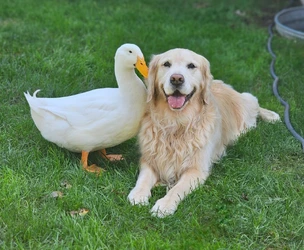
Louie, a Pekin duck, and Barley, a golden retriever, met in 2024 when Barley was starting epilepsy treatment and Louie was just 4 days old. (Tori Cannarelli)
For months, Barley was not herself.
The golden retriever, now 7 years old, was diagnosed with epilepsy in February 2024 after a string of seizures. Although medication made the seizures stop, it also dulled Barley’s personality.
“She lost her goldenness, her fun, her spunk,” said Tori Cannarelli, Barley’s owner who lives in Brookhaven, a suburban town on Long Island. “She was always sleeping or mopey. It was heartbreaking.”
But Barley’s playfulness began to reemerge in May 2024, when a 4-day-old duckling arrived at their home. Barley stuck her snout into the duckling’s small enclosure, and the two locked eyes. It was then that an unlikely friendship was born.
When Barley first met Louie, they made eye contact and became fast friends. (Tori Cannarelli)
“They fell in love with each other instantly,” Cannarelli said. “It was the weirdest thing.”
The duckling showed up at their house after Cannarelli’s husband saw a Facebook post by an elementary-school teacher looking to rehome two ducklings. Her husband said he planned to keep them at their house just for the weekend before bringing them to the local garden center he runs. One of the two ducklings died on the first night.
Louie when he arrived at the Cannarellis’ house in May 2024. (Tori Cannarelli)
“We don’t know why,” Cannarelli said, explaining that they believe the animal was ill when it arrived at their home.
The surviving duckling, an American Pekin they named Louie, never made it to the garden center. They kept him because Cannarelli suspected the tiny duck was bringing Barley back out of her shell.
0:12
(Video: Tori Cannarelli)
“Maybe she was lonely, I’m not really sure,” Cannarelli said, adding that their vet said behavioral changes can happen when dogs start epilepsy medication.
Within a few weeks, Barley and Louie were inseparable. Every morning, Barley would go to Louie’s outdoor pen, which has a wind-protected shed and a small pool.
Louie’s outdoor pen, a favorite morning stop for Barley. (Tori Cannarelli)
“You don’t expect that friendship, and it’s nice to see,” Cannarelli said.
Pekin ducks are domesticated, cannot fly and don’t exist in the wild. They can live up to 12 years.
0:09
(Video: Tori Cannarelli)
“The duck is constantly following around the dog,” said Cannarelli, who has two children, ages 9 and 11. “They roll around together all day long.”
They occasionally wrestle — though always gently, Cannarelli said.
“Every now and then, she’ll get the zoomies and romp around and play with the duck as if he’s a puppy,” Cannarelli said.
They also spar over food. Louie is a vegetarian, and his favorite foods are tomatoes, peas and cucumbers, which Barley enjoys, too. They often snag bites from each other’s dishes, and Louie prefers eating out of a dog bowl to eating out of a duck feeder.
“The duck has no idea he’s a duck. He thinks he’s a dog,” Cannarelli said.
That impression isn’t just a joke, said Stanley Coren, professor emeritus of psychology at the University of British Columbia and the author of “How to Speak Dog.”
“If you’re getting these heterogeneous species living together,” Coren said, “they will pick up on the behaviors of the others who they’re living with.”
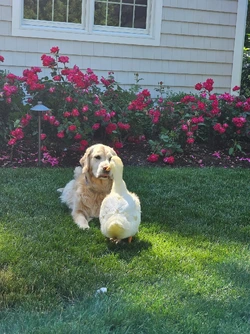
In the Cannarellis’ backyard, Barley and Louie go snout to beak. (Tori Cannarelli)
Golden retrievers, Coren added, are among the breeds most likely to form this kind of bond with another species.
“If you presented a duck to a terrier, the duck is gone,” Coren said. “Retrievers are much more interested in retrieving than they are in hunting.”
In this case, the timing mattered, too. Although dogs are predators and ducks are prey, young mammals give off pheromones that can sometimes trigger a protective instinct in animals around them — especially females, according to Coren.
“That means the initial contact which the dog makes with the duck is going to have this protective mothering kind of a halo,” he said, noting that he doubts the bond would have formed the same way if Louie was an adult duck when he met Barley. “Over time, that can turn into a friendship.”
Coren said he is not surprised Barley perked up after Louie appeared.
“Dogs are highly sociable and so are ducks, so they feel more comfortable having somebody familiar and nonthreatening nearby,” he said. “There really is an emotional bond, and it can be cross-species.”
Shortly after Louie arrived at their home, Cannarelli started an Instagram account to chronicle their unusual relationship. She had been sending her colleagues photos and videos when they suggested she make an account.
“I started it as a joke for the office girls,” Cannarelli said.
For two years, the account had a relatively small following, but in the past few months, it suddenly took off. Some of her videos have drawn millions of views.
0:23
(Video: Tori Cannarelli)
“I’m completely blown away,” said Cannarelli, who refers to Louie as Barley’s “emotional support duck.”
People online are charmed by their dynamic.
“This beautiful story should be a book for kids,” someone commented on a recent post.
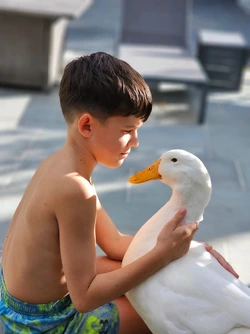
Cameron, 11, with Louie. (Tori Cannarelli)
Cannarelli said having a pet duck is not for everyone.
“They’re very messy, they’re a lot of work,” she said. “You really have to love them and take care of them and keep them clean.”
Still, she said, Louie has become a fixture in their family.
Louie and Barley enjoy the sunshine together. (Tori Cannarelli)
“We all got attached to him. … It’s not something I thought was ever going to be in my future, but now that he’s here, I seriously love him,” Cannarelli said. “He’s even on our Christmas card.”
She said she plans to continue sharing Barley and Louie’s friendship.
“I want to give people something to smile about,” she said.
I do have one morbid question
Do live ducks just not trigger a retriever's prey drive or what, what happens in the dog's head that says "this prey animal isn't for eating" (yeah I know it's labradors not goldens that do duck retrieving)
Like for example I'd never bring my dog to the house of someone who has a rabbit just to err on the side of caution
I do have one morbid question
Do live ducks just not trigger a retriever's prey drive or what, what happens in the dog's head that says "this prey animal isn't for eating" (yeah I know it's labradors not goldens that do duck retrieving)
Like for example I'd never bring my dog to the house of someone who has a rabbit just to err on the side of caution
Retrievers aren't hunting dogs, they are retrievers. But a Collie or a shepherd raised with livestock won't hunt either. I've had to re-home puppies that wanted to chase livestock, the only other option is to..
In this case, the timing mattered, too. Although dogs are predators and ducks are prey, young mammals give off pheromones that can sometimes trigger a protective instinct in animals around them — especially females, according to Coren.
If this really scratches an itch for you, despite them being a despicable heathen cult, Jehovah's witnesses have some kick ass art of the world to come.
Dogs are very social animals which is why they are paired with animals that may have anxiety issues. There are places that give Cheetahs a dog buddy like golden retrievers to help them with confidence and to not feel isolated. Capybaras are also friendly too and plenty of different animals will hang out with them in the wild including even at times predators.
I do have one morbid question
Do live ducks just not trigger a retriever's prey drive or what, what happens in the dog's head that says "this prey animal isn't for eating" (yeah I know it's labradors not goldens that do duck retrieving)
Like for example I'd never bring my dog to the house of someone who has a rabbit just to err on the side of caution
The reason why is usually due to species, breed and environmental upbringing but there are exception to those rules. Pups and kittens who have hanged around with each other since the start will be usually fine with each other when they are adults. It also helps that domesticated animals act differently to those in the wild thanks to human interaction.