You can also tell they over sampled democrats to create a false narrative.
"Exceedes his authority" has a 83 to 24 split in dem favor. So with both sides having equal numbers, the split should be 54 percent support, yet it has 59 percent.
Same with "strong president" which has a 20 to 86 split in republican favor. So it should be 53%, if both sides had the same number of respondents, yet combined support is 48 percent
Really shows you how they lie with polls and gaslight everyone.
I think this is a misunderstanding of what oversampling is; my apologies if anyone else already addressed this, but I didn't see it in search.
So first things first: you're wrong. Take a look at
their crosstabs (
archive)
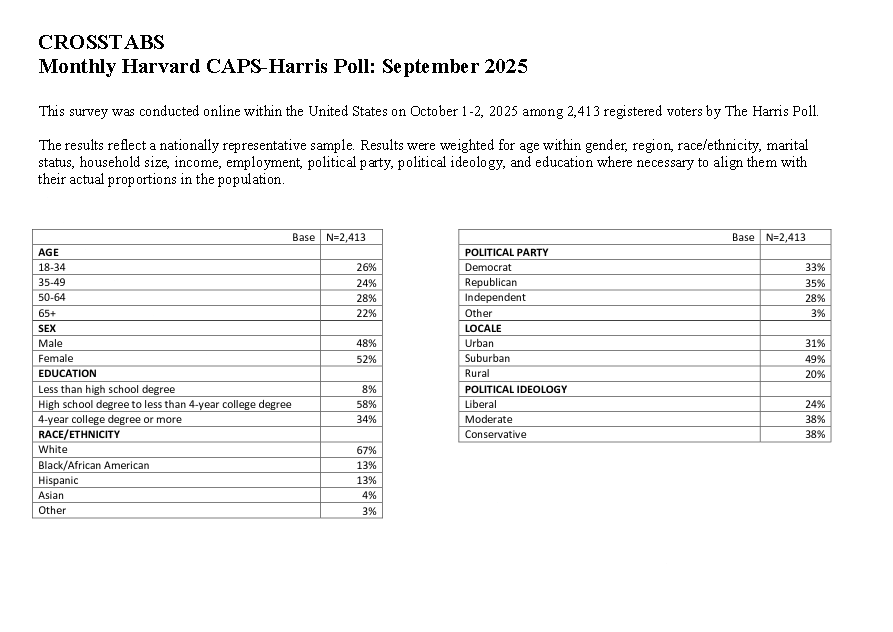
As you can see, they actually spoke to slightly more Republicans than Democrats (and nearly as many Independents (I presume self-identified)). However, they also say that they weighted based on many factors, including party affiliation, meaning they took existing information about the proportion of Democrats and Republicans in the population and adjusted the aggregate results based on that. So if they had spoken to more Ds than Rs, it wouldn't matter, they assumed beforehand they knew the actual proportion and weighted the results to line up with that proportion. Note that there are pitfalls associated with weighting by party affiliation! If self-reported party affiliation proportions in polling samples are shifting faster than actual registrations, especially the proportion of the population identifying as independent, that itself tells you a lot about what's going on with people's perception of politics!
So what actually is oversampling? Well, take a look at the percentage Asian respondents, 4%. They gathered 2413 responses, meaning they had around 100 Asian responses. All of a sudden their polling sample doesn't look so impressive when it comes to telling you confidently how Asians think! To really show how this can be a problem, let's imagine they got even more granular racial data, and broke the Asian responses out to subgroups like Cambodians. Likely enough, you could have gotten a sample size of just like 2 of them, and it's not that unlikely to get 100% of them telling you the same thing on a poll question; but you'd be retarded to assume that allowed you to say that 100% of the Cambodian vote disapproves of Trump. So if you
do want to be the pollster who can report what the Cambodian vote really thinks, you have to consciously attempt to gather more of their responses, disproportionate to their share of the electorate, until you have a large enough sample; otherwise when the one town in America that's majority Cambodian votes for Trump, you'll look like a moron. The thing is, if you're consciously oversampling, it would be malpractice not to weight the results afterwards; in any case, they didn't actually seem to report demographic breakdown of these questions other than partisan, and it doesn't look to me like they oversampled anything (they don't have any reason to do so if they're not going to break down the results along those lines).


