They found safe spaces on TikTok. A ban could devastate their communities.
By Kelsey Ables
and
Jennifer Hassan
April 25, 2024 at 11:53 p.m. EDT
Some TikTok community members expressed deeper anxiety over the potential loss of their close-knit circles on the app. (Video: The Washington Post/Courtesy of Sam Reall; Gabrielle Valdez; Jackie Gonzalez; Kristie Carnevale)
Listen
Comment648

President Biden signed legislation Wednesday that could ban TikTok, leaving users in the United States who have spent years building a home on the platform worried about losing the communities they have come to cherish.
As talk of a potential ban escalated, creators encouraged fellow users to contact lawmakers and voice their discontent about the measure, which is rooted in security concerns over the app’s Chinese ownership. TikTok’s parent company, ByteDance, has roughly nine months to sell the app to a U.S. company — or TikTok could be banned nationally.
TikTok chief executive Shou Zi Chew said a ban would take the platform away from the 170 million Americans who use it. “Make no mistake, this is a ban — a ban on TikTok and a ban on you and your voice,” he said, adding: “We are not going anywhere.”
After the Senate vote, some users scrambled to ask their communities, “What platform are we going to now?”
Others, particularly some with stigmatized interests or marginalized identities, expressed deeper anxiety over the potential loss of close-knit circles built through TikTok that could prove difficult to rebuild elsewhere.
“We’ve already built such a strong ecosystem on TikTok,” said Jackie Gonzalez, who has found comfort and community on #DeafTok. “To tear that down and force us to rebuild somewhere else would be a setback for sure.”
TourettesTok
Sam Reall, 21, was diagnosed with Tourette’s syndrome when he was 6. As he navigated his early years, he tried his best to hide the relentless tics — the sudden movements and sounds caused by the condition, for which there is no cure. Isolated and confused, Reall believed he was “cursed.”
“I didn’t know anyone else had the same condition and felt very much alone,” said Reall, from Illinois.
Play now
Follow on
Podcast episode
TikTok might get banned. For real this time.
The Senate is expected to pass a bill that would force TikTok’s parent company to sell the platform or face a national ban. How did Congress achieve consensus?
That changed in 2021, when he began posting to TikTok in a bid to raise awareness of the condition, which about 1.4 million people in the United States have, according to the CDC.
Follow Technology
What came next were “hundreds of conversations” between Reall and others like him, plus conversations with their loved ones and family members. Reall said he has made “lifelong friends” thanks to the Tourette’s community on TikTok, become more confident and even stopped hiding his tics. He’s also helped others get diagnosed and seek medical help.

Skip to main content
AConversationwithTourettesPart8#aconversationwithtourettes# ...See more
“I have had people tell me they were able to better understand their condition as a result of my content,” he said, adding that if such a platform existed when he was younger, it would have “completely changed” his childhood.
The proposed TikTok ban would be “a huge step backward for the community,” Reall said. Trying to move it elsewhere just wouldn’t work, he said, noting that he often posts his videos to Instagram, but they do not reach as many people.
DeafTok
While growing up, Jackie Gonzalez did what many deaf or hard of hearing people do in a hearing-centered world: She learned to read lips. It was “for survival,” the Austin-based business owner said via email, “with those around me oblivious to the work I was doing in order to connect.”
Years later, Gonzalez’s TikTok videos on deafness — including a series in which she lip-reads conversations of celebrities caught on camera — have racked up millions of views.
Skip to main content
IdontknowwhoIrelatetomore#deaftok#deaf#lipreading#lipreadingg ...See more
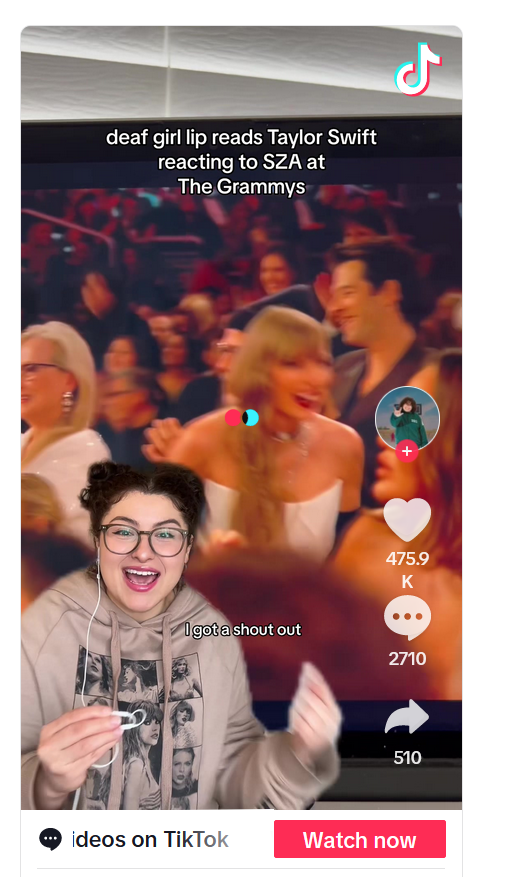
“TikTok has seen this ability and has acknowledged it in a way I never could have dreamed of,” Gonzalez said. “It feels good.”
At the heart of what users call “DeafTok” is a world where being deaf doesn’t mean missing out. On DeafTok, being able to turn off hearing aids on a noisy plane is a perk. Music can be enjoyed through vibrations, and lip-reading is treated not just as a survival strategy but as a talent.
Elizabeth Harris also found support on the platform, making American Sign Language covers of popular songs and talking about everyday experiences, like going to the movies on a date and wearing closed-caption glasses.
Harris, 22, plans to keep posting her work on other platforms if TikTok is banned, but she said she doesn’t think she can re-create the same kind of community on Instagram “because how someone engages on TikTok is different,” she wrote in an email.
She asked followers in a March video about what they plan to do if there’s a ban, saying, “I feel like we’re together and we’re connected, and I don’t want to lose that.”
GriefTok
For people who are grieving, TikTok can serve as a digital diary, one that helps them log the mourning process of those they have lost — parents, siblings, children and pets — and navigate life without them.
Three-year-old Auria Valdez loved trees and rain and jumping in puddles. She considered squirrels her friends. In 2018, she died of a rare and aggressive form of cancer.

Skip to main content
Replyingto@


 ThereistrulysmmoretoherstorybutIdidthe ...See more
In the years since her death, her mother, Gabrielle Valdez, has used TikTok to raise awareness of childhood cancer, to find coping tools and to connect with others experiencing loss.
“You never think your child can get cancer, and you definitely never think they can die,” she said. “I am proof that both can happen, so I used my journey to help others.”
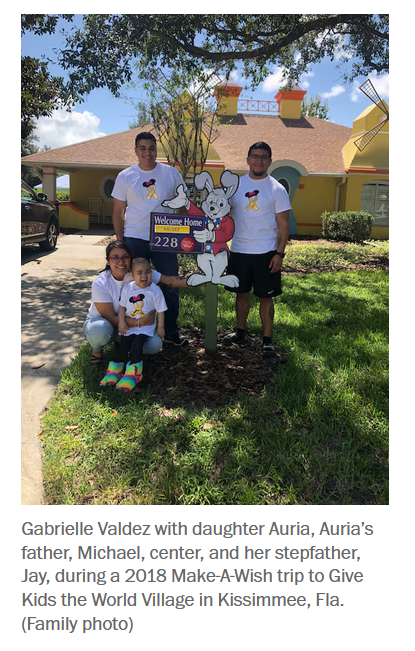
Gabrielle Valdez with daughter Auria, Auria’s father, Michael, center, and her stepfather, Jay, during a 2018 Make-A-Wish trip to Give Kids the World Village in Kissimmee, Fla. (Family photo)
Valdez, 30, said growing a community on TikTok was easier than on other platforms where she felt she had to “pay” her “way to be heard.” TikTok provided her with global reach and positive engagement through use of hashtags like #grieftok and #childloss, she said.
Valdez said her account helps her and others talk about death “in a world that doesn’t prepare us ahead of time for it.” Without TikTok as an outlet for her grief, she worries that she will “go back to holding that all in.”
Carson Drain, 29, first took to TikTok in 2022, after losing both her parents the previous year, just one month apart.
“I would lose an entire community,” Drain said Wednesday of the platform’s potential ban, explaining that no one in her personal life had been able to relate to her double loss. But she found “a steady community and support system” on TikTok among others who had lost parents — an important part of her healing process.
“TikTok made me realize that I wasn’t alone in my sadness, anger and depression.”
Romance BookTok
Kristie Carnevale, 34, posted her first romance #BookTok video on a solo Christmas Eve during the pandemic and quickly found a place where she could openly discuss the “spicy books” she’s enjoyed since the “Fifty Shades of Grey” craze. Three years later, the Detroit-based business owner generates much of her business through TikTok. But that first night speaks to why she stuck around.
“It really spawned out of loneliness and the urge for community and having someone to talk to,” Carnevale said.
For a long time, the genre “was seen as a guilty pleasure” she said. “You didn’t tell people you read romances.”
But over the past few years, the romance #BookTok community has flourished, making strides in changing the perception of the genre — which Carnevale notes is “a women-led part of the industry,” with books that center on women’s stories and desires.

Skip to main content
GIVEMEADVICE!#booktok#readbetweenthewines ...See more
Tanya Baker, who joined the community in 2021, said that while there is still progress to be made, it “has made so many people open and comfortable” with reading romance books and “talking about them with no shame.”
On her account, Baker, 28, dives into various tropes, recommends books and shares bookish lifestyle content. The Southern California-based creator said the work on TikTok allowed her to quit her 9-to-5 job and has been a source of lifelong friendships that she credits, in part, to the subject matter.
“Some of the topics that are discussed in romance books are deeply personal and it brings forth a certain amount of vulnerability,” she said, “for someone to openly say they loved a book and detail why.”
Baker said she is devastated by the news of a potential ban. “I don’t believe the magic on BookTok can be recreated/duplicated,” she wrote.
When Carnevale thinks about a potential ban, “it breaks my heart,” she said. She worries for creators like herself who make a living on the platform, but she also fears losing what she calls “a little corner of happy in a really, really tough world right now.”
Kelsey Ables is a reporter at The Washington Post's Seoul hub, where she covers breaking news in the United States and across the world. She was previously on the Features desk, where she wrote about art, architecture and pop culture. Twitter
Jennifer Hassan is a London-based breaking-news reporter for the Foreign desk at The Washington Post. Before joining The Post in 2016, Jennifer honed her breaking-news skills as the U.K. social media editor at MailOnline. Twitter
More From The Post
NewsletterAs news breaks
Tech News Alerts
Breaking news email alerts on technology and the tech industry.
This conversation is moderated according to The Post's community rules. Please read the rules before joining the discussion. If you’re experiencing any technical problems, please contact our customer care team.
Sort by
expand_more
(+)
Source : https://archive.is/BNAAT
https://www.washingtonpost.com/technology/2024/04/25/tiktok-ban-bill-us-communities/ (hard paywall, though)
By Kelsey Ables
and
Jennifer Hassan
April 25, 2024 at 11:53 p.m. EDT
Some TikTok community members expressed deeper anxiety over the potential loss of their close-knit circles on the app. (Video: The Washington Post/Courtesy of Sam Reall; Gabrielle Valdez; Jackie Gonzalez; Kristie Carnevale)
Listen
Comment648
President Biden signed legislation Wednesday that could ban TikTok, leaving users in the United States who have spent years building a home on the platform worried about losing the communities they have come to cherish.
As talk of a potential ban escalated, creators encouraged fellow users to contact lawmakers and voice their discontent about the measure, which is rooted in security concerns over the app’s Chinese ownership. TikTok’s parent company, ByteDance, has roughly nine months to sell the app to a U.S. company — or TikTok could be banned nationally.
TikTok chief executive Shou Zi Chew said a ban would take the platform away from the 170 million Americans who use it. “Make no mistake, this is a ban — a ban on TikTok and a ban on you and your voice,” he said, adding: “We are not going anywhere.”
After the Senate vote, some users scrambled to ask their communities, “What platform are we going to now?”
Others, particularly some with stigmatized interests or marginalized identities, expressed deeper anxiety over the potential loss of close-knit circles built through TikTok that could prove difficult to rebuild elsewhere.
“We’ve already built such a strong ecosystem on TikTok,” said Jackie Gonzalez, who has found comfort and community on #DeafTok. “To tear that down and force us to rebuild somewhere else would be a setback for sure.”
TourettesTok
Sam Reall, 21, was diagnosed with Tourette’s syndrome when he was 6. As he navigated his early years, he tried his best to hide the relentless tics — the sudden movements and sounds caused by the condition, for which there is no cure. Isolated and confused, Reall believed he was “cursed.”
“I didn’t know anyone else had the same condition and felt very much alone,” said Reall, from Illinois.
Play now
Follow on
Podcast episode
TikTok might get banned. For real this time.
The Senate is expected to pass a bill that would force TikTok’s parent company to sell the platform or face a national ban. How did Congress achieve consensus?
That changed in 2021, when he began posting to TikTok in a bid to raise awareness of the condition, which about 1.4 million people in the United States have, according to the CDC.
Follow Technology
What came next were “hundreds of conversations” between Reall and others like him, plus conversations with their loved ones and family members. Reall said he has made “lifelong friends” thanks to the Tourette’s community on TikTok, become more confident and even stopped hiding his tics. He’s also helped others get diagnosed and seek medical help.
Skip to main content
AConversationwithTourettesPart8#aconversationwithtourettes# ...See more
“I have had people tell me they were able to better understand their condition as a result of my content,” he said, adding that if such a platform existed when he was younger, it would have “completely changed” his childhood.
The proposed TikTok ban would be “a huge step backward for the community,” Reall said. Trying to move it elsewhere just wouldn’t work, he said, noting that he often posts his videos to Instagram, but they do not reach as many people.
DeafTok
While growing up, Jackie Gonzalez did what many deaf or hard of hearing people do in a hearing-centered world: She learned to read lips. It was “for survival,” the Austin-based business owner said via email, “with those around me oblivious to the work I was doing in order to connect.”
Years later, Gonzalez’s TikTok videos on deafness — including a series in which she lip-reads conversations of celebrities caught on camera — have racked up millions of views.
Skip to main content
IdontknowwhoIrelatetomore#deaftok#deaf#lipreading#lipreadingg ...See more
“TikTok has seen this ability and has acknowledged it in a way I never could have dreamed of,” Gonzalez said. “It feels good.”
At the heart of what users call “DeafTok” is a world where being deaf doesn’t mean missing out. On DeafTok, being able to turn off hearing aids on a noisy plane is a perk. Music can be enjoyed through vibrations, and lip-reading is treated not just as a survival strategy but as a talent.
Elizabeth Harris also found support on the platform, making American Sign Language covers of popular songs and talking about everyday experiences, like going to the movies on a date and wearing closed-caption glasses.
Harris, 22, plans to keep posting her work on other platforms if TikTok is banned, but she said she doesn’t think she can re-create the same kind of community on Instagram “because how someone engages on TikTok is different,” she wrote in an email.
She asked followers in a March video about what they plan to do if there’s a ban, saying, “I feel like we’re together and we’re connected, and I don’t want to lose that.”
GriefTok
For people who are grieving, TikTok can serve as a digital diary, one that helps them log the mourning process of those they have lost — parents, siblings, children and pets — and navigate life without them.
Three-year-old Auria Valdez loved trees and rain and jumping in puddles. She considered squirrels her friends. In 2018, she died of a rare and aggressive form of cancer.
Skip to main content
Replyingto@
ThereistrulysmmoretoherstorybutIdidthe ...See moreIn the years since her death, her mother, Gabrielle Valdez, has used TikTok to raise awareness of childhood cancer, to find coping tools and to connect with others experiencing loss.
“You never think your child can get cancer, and you definitely never think they can die,” she said. “I am proof that both can happen, so I used my journey to help others.”
Gabrielle Valdez with daughter Auria, Auria’s father, Michael, center, and her stepfather, Jay, during a 2018 Make-A-Wish trip to Give Kids the World Village in Kissimmee, Fla. (Family photo)
Valdez, 30, said growing a community on TikTok was easier than on other platforms where she felt she had to “pay” her “way to be heard.” TikTok provided her with global reach and positive engagement through use of hashtags like #grieftok and #childloss, she said.
Valdez said her account helps her and others talk about death “in a world that doesn’t prepare us ahead of time for it.” Without TikTok as an outlet for her grief, she worries that she will “go back to holding that all in.”
Carson Drain, 29, first took to TikTok in 2022, after losing both her parents the previous year, just one month apart.
“I would lose an entire community,” Drain said Wednesday of the platform’s potential ban, explaining that no one in her personal life had been able to relate to her double loss. But she found “a steady community and support system” on TikTok among others who had lost parents — an important part of her healing process.
“TikTok made me realize that I wasn’t alone in my sadness, anger and depression.”
Romance BookTok
Kristie Carnevale, 34, posted her first romance #BookTok video on a solo Christmas Eve during the pandemic and quickly found a place where she could openly discuss the “spicy books” she’s enjoyed since the “Fifty Shades of Grey” craze. Three years later, the Detroit-based business owner generates much of her business through TikTok. But that first night speaks to why she stuck around.
“It really spawned out of loneliness and the urge for community and having someone to talk to,” Carnevale said.
For a long time, the genre “was seen as a guilty pleasure” she said. “You didn’t tell people you read romances.”
But over the past few years, the romance #BookTok community has flourished, making strides in changing the perception of the genre — which Carnevale notes is “a women-led part of the industry,” with books that center on women’s stories and desires.
Skip to main content
GIVEMEADVICE!#booktok#readbetweenthewines ...See more
Tanya Baker, who joined the community in 2021, said that while there is still progress to be made, it “has made so many people open and comfortable” with reading romance books and “talking about them with no shame.”
On her account, Baker, 28, dives into various tropes, recommends books and shares bookish lifestyle content. The Southern California-based creator said the work on TikTok allowed her to quit her 9-to-5 job and has been a source of lifelong friendships that she credits, in part, to the subject matter.
“Some of the topics that are discussed in romance books are deeply personal and it brings forth a certain amount of vulnerability,” she said, “for someone to openly say they loved a book and detail why.”
Baker said she is devastated by the news of a potential ban. “I don’t believe the magic on BookTok can be recreated/duplicated,” she wrote.
When Carnevale thinks about a potential ban, “it breaks my heart,” she said. She worries for creators like herself who make a living on the platform, but she also fears losing what she calls “a little corner of happy in a really, really tough world right now.”
Kelsey Ables is a reporter at The Washington Post's Seoul hub, where she covers breaking news in the United States and across the world. She was previously on the Features desk, where she wrote about art, architecture and pop culture. Twitter
Jennifer Hassan is a London-based breaking-news reporter for the Foreign desk at The Washington Post. Before joining The Post in 2016, Jennifer honed her breaking-news skills as the U.K. social media editor at MailOnline. Twitter
More From The Post
NewsletterAs news breaks
Tech News Alerts
Breaking news email alerts on technology and the tech industry.
This conversation is moderated according to The Post's community rules. Please read the rules before joining the discussion. If you’re experiencing any technical problems, please contact our customer care team.
Sort by
expand_more
(+)
Source : https://archive.is/BNAAT
https://www.washingtonpost.com/technology/2024/04/25/tiktok-ban-bill-us-communities/ (hard paywall, though)


