Link Archive
Perspective by Eliot Schrefer
June 30, 2022 at 8:55 a.m. EDT
In 1913, naturalists captured a flock of penguins from the Antarctic and brought them to spend the rest of their lives in the Edinburgh Zoo. The birds that survived the transition came to enchant the Scottish public with their antics. They could go from suave to goofy and back again, simply by gliding in the water, toddling around on land for a bit, then diving in once more.
Over the years, the zookeepers struggled to determine which penguins were male and which were female, renaming four of the five in the process. The complications only grew from there. Like most birds, penguins are socially but not sexually monogamous. Though they form lifelong unions, they are very happy to canoodle on the side — and there were only so many sexual configurations five of them could go through before one truth became self-evident: The penguins were bisexual. As zoo director T.H. Gillespie wryly observed in his 1932 recounting of these sexual triangulations, they “enjoy privileges not as yet permitted to civilized mankind.”
Bi penguins have been stirring things up for over a century. The first record of same-sex sex in penguins was in 1911, when explorer George Murray Levick discovered “depraved” behavior in wild Adélies. In 2000, a pair of male chinstrap penguins at New York City’s Central Park Zoo bonded and raised a chick from an egg they’d been given to foster, inspiring the children’s book “And Tango Makes Three.” More recently, penguin behavior sounded like it was ripped straight from a celebrity gossip site when it emerged that two male penguins had stolen an egg from a hetero couple at a Dutch zoo — and then proceeded to steal an egg from a “lesbian” couple the very next year.
Penguins aren’t the only sexually adventuresome animals. Over the past 20 years, a burst of research — driven in part by a new generation of scientists more accepting of queerness — has shown significant amounts of previously unreported homosexual behavior throughout the animal kingdom, from flour beetles to gorillas. While few animals are exclusively “gay” or “lesbian,” an extraordinary number, it appears, engage in some form of same-sex relations. There are now reputable evidence-confirmed findings of such behavior in 1,500 animal species and counting.
As a graduate student in animal studies, I’ve often faced an unpleasant prospect: The theory of natural selection, at least as it’s classically considered, could argue that queerness shouldn’t exist. In a Noah’s Ark conception of life, with dutifully procreating male-female pairs for each animal species, non-straight behavior seems to disrupt the natural order by preventing the transmission of genes over generations. This conundrum has started to feel far more than academic in recent months, as multiple states have passed legislation restricting reading about or even discussing LGBTQIA+ identities in schools. The logic behind such laws, it seems to me, goes something like this: If queerness doesn’t come about naturally, then it can be walled out of human populations by limiting access to the very idea of it.
The recent surge in same-sex animal scholarship, however, offers a powerful challenge to that thinking. For hundreds of years, it turns out, we’ve been looking at animal sex through too narrow a lens — with significant consequences for our beliefs about what counts as natural in our own species.
Christian theologians have long pointed to the absence of animal homosexuality as evidence that humans oughtn’t to be doing it, either. Thirteenth-century philosopher and priest Thomas Aquinas argued that homosexual behavior in humans is wrong precisely because it doesn’t occur between animals. He saw it as a sign of decadence — a falling down from our state of animal grace into the world of human corruption.
The assumption of heterosexuality among animals took its first major hit in 1834, when August Kelch, an entomologist, discovered two male Melolontha melolontha — beetles commonly known as cockchafers or doodlebugs — having sex. He concluded that it had to be an act of rape. As he initially framed it in a German scientific journal, “the larger and stronger of the two had forced itself on the smaller and weaker one, had exhausted it and only because of this dominance had conquered it.”
The puzzle of mating males captured the imagination of entomologists, who busily published articles about it for years. As science historian Ross Brooks chronicled in 2009 in the Archives of Natural History — in an article titled “All too human: responses to same-sex copulation in the common cockchafer” — some scientists proposed that the receiving males were being mistaken for females. Others offered still different explanations, but it wasn’t until 1896 that someone dared to put forward a radical suggestion: In a paper published even as Oscar Wilde sat in prison for “gross indecency,” Henri Gadeau de Kerville, a leading French entomologist, theorized that some of the doodlebugs just … preferred it (“pédérastie par goût”). He was thoroughly scolded by his colleagues — at which point the question of same-sex doodlebug sex, after having been bandied about for much of the 19th century, mostly dropped from scientific discourse.
Did scientists avoid publishing on same-sex animal sex because they were worried about being scolded as Gadeau de Kerville was? Or did they simply find it shameful? George Murray Levick, the explorer who wrote about homosexual behavior in Adélie penguins in 1911, shielded his observations of penguin “depravity” from casual observers by recording them in his field notes using the Greek alphabet — and they were still cut from the official expedition reports. A prominent mammalogist, Valerius Geist, couldn’t help but notice frequent homosexual sex at his bighorn sheep field site in the 1960s, but Geist avoided publishing those findings because it made him “cringe … to conceive of those magnificent beasts as ‘queers.’ ” Years later he relented, writing that he eventually “admitted that the rams lived in essentially a homosexual society.” As for those scientists who did want to write about same-sex sexual behavior in animals, one option was to couch it in the judgmental language used for humans — as in a 1922 study on baboons called “Disturbances of the Sexual Sense,” or a 1987 study of same-sex mating in butterflies titled “A Note on the Apparent Lowering of Moral Standards in the Lepidoptera.”
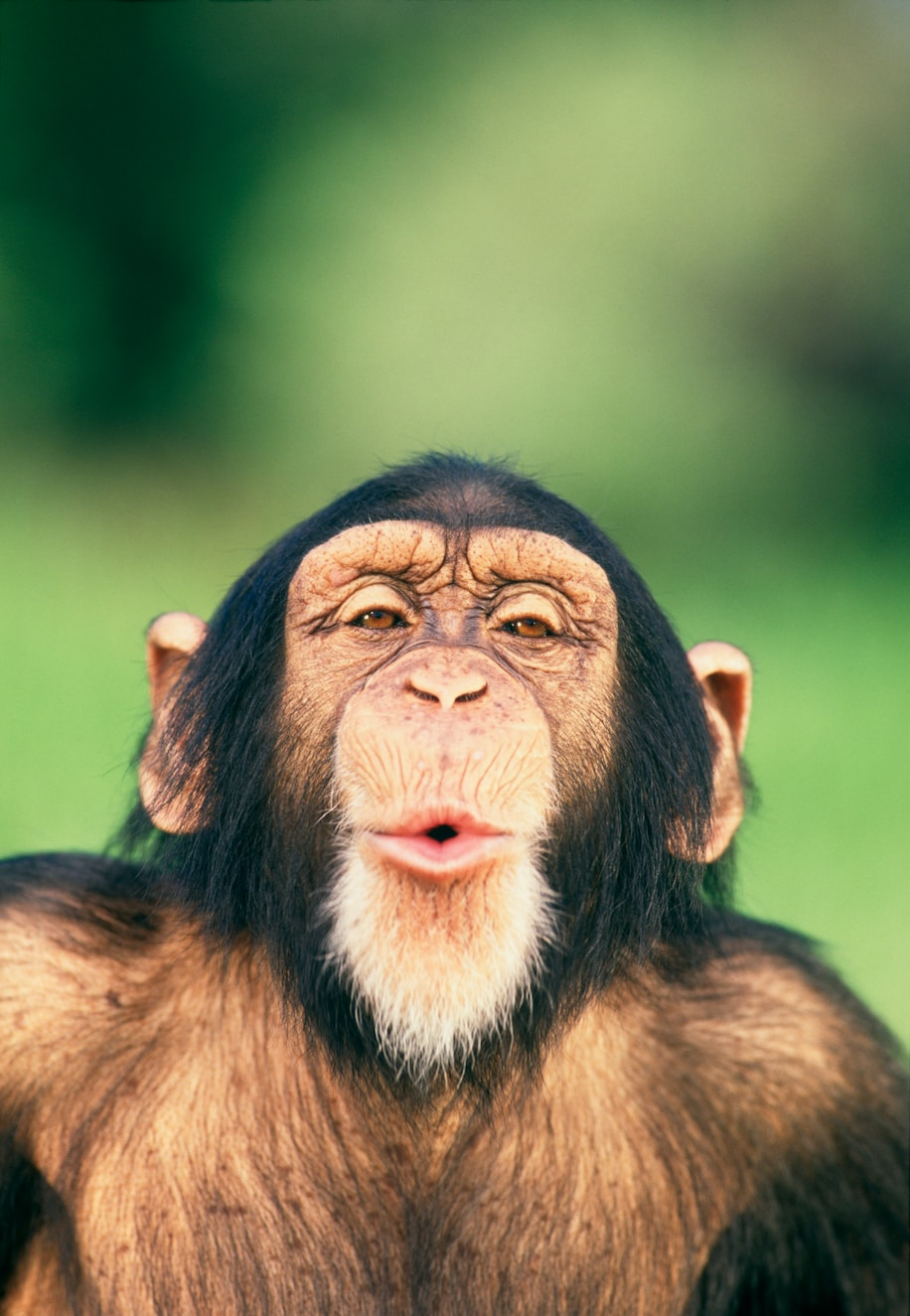
Research has shown that chimpanzees use sex for more than procreation; male chimps engage in sexual activity to reconcile after fights. (Fuse/Getty Images/Corbis RF Stills)
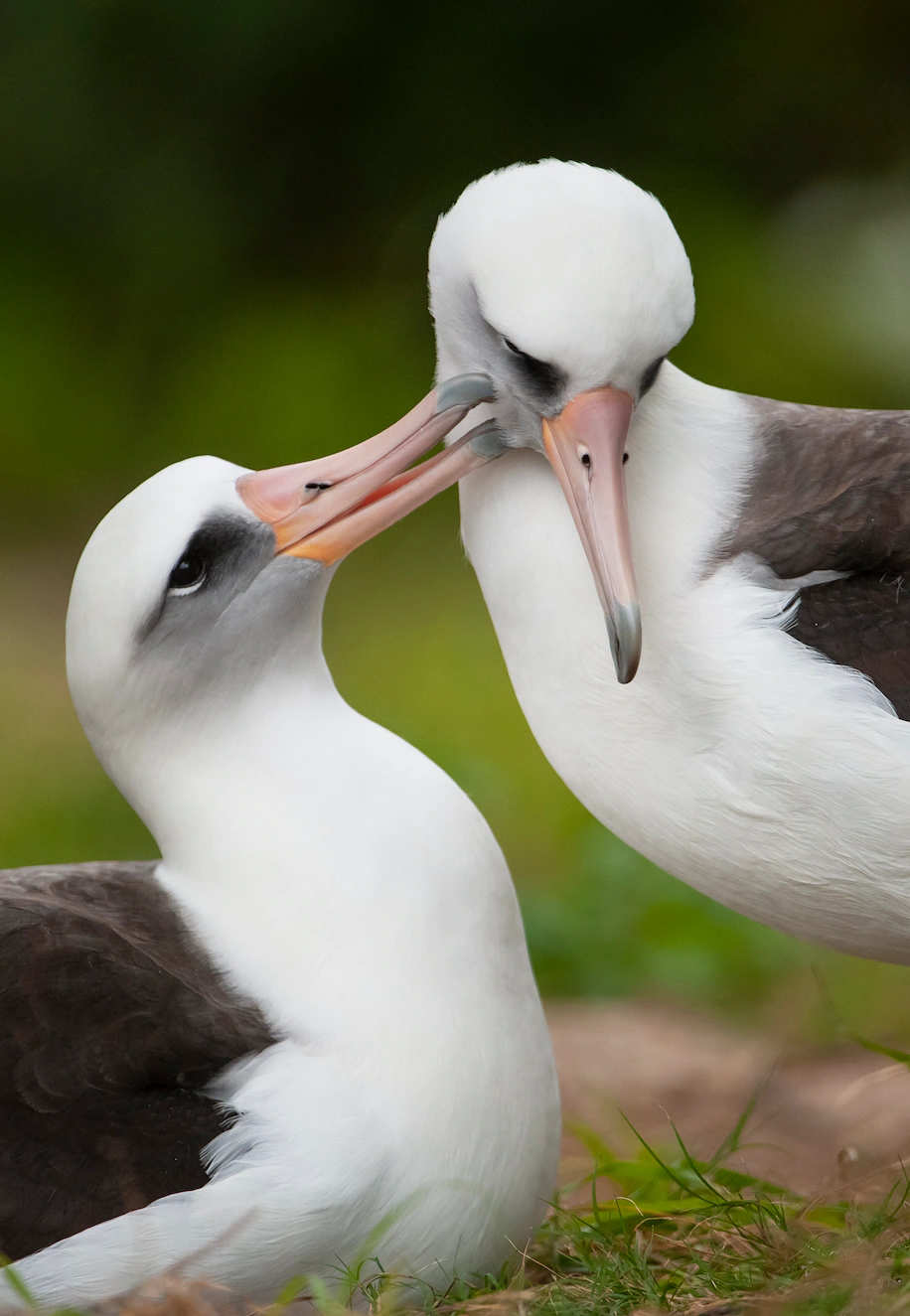
Up to a third of Laysan albatross nests are female-female. (Enrique Aguirre Aves/Getty Images/Photodisc)
The minimizing of animal sexual diversity was not only about discomfort. Christine Webb, a primatologist at Harvard’s Department of Human Evolutionary Biology, explains that the dominant model of evolution “emphasizes selfish competition and the survival of the fittest.” But the chimpanzees Webb studies use sex for a variety of purposes, such as managing stress and tension. Once she and the co-authors of her recent paper allowed for observations that contradicted their assumptions that chimps had sex for procreation only, they made a breakthrough discovery: Males engage in sexual activity to reconcile after fights.
A year later, a study of a separate group of chimps in Uganda found that “sociosexual behaviour” is common — and that the majority of it is between males.
This research is hardly an outlier. Coldblooded male garter snakes use pheromones to encourage courtship from other males in the area, forming “mating balls,” perhaps to help warm up individuals whose temperatures have gotten dangerously low. Polyamory — the bonding of three or more animals, instead of the conventional two — expands the numbers of parents for each offspring, increasing their survivability, and can be found in many species of waterfowl, most famously the graylag goose. Female-female pair bonds in birds such as gulls, roseate terns and albatrosses average more eggs (which are fertilized by sex outside the union) per nest. The fact that a bird population with many bonded females sharing a few males between them would have higher reproductive output led historian and ornithologist Jared Diamond to dryly wonder whether “further study of homosexually paired female birds may help clarify what, if anything, males are good for — in an evolutionary sense, of course.”
Evolutionary biologist Mounica Kota is a fan of Laysan albatrosses, for whom up to a third of the nests are female-female. “They’re like my lesbian moms. I have a big photograph of them in my office,” she told me. She’s part of the new generation of openly LGBTQIA+ scientists who are frank about how their personal identity aligns with their professional research, even if it opens them to accusations of partiality. Kota, who is a lesbian, struggled with coming out earlier in life, and she was heartened by a class in animal behavior that she took as an undergrad.
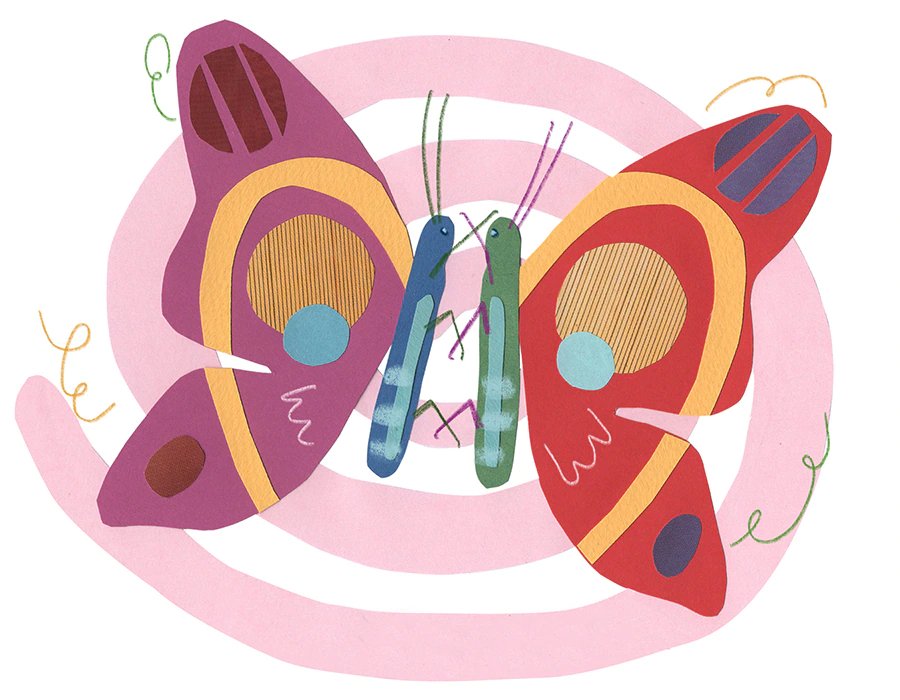
(Ælfleda Clackson for The Washington Post)
Sidney Woodruff, a PhD candidate in ecology at the University of California at Davis, has been studying conservation of the western pond turtle, which lacks sex chromosomes and whose sex is instead determined by incubation temperatures — a phenomenon turtle researchers dub “girls are hot, boys are cool.” Woodruff, who identifies as nonbinary and queer, feels kinship with animals who also cross sexual binaries — but they treat this personal element as a source of caution as much as anything else. “I have to keep in mind that if I’m researching sex and wildlife species, I’ll want it to be a certain way because of my own gender and sexual identity,” Woodruff told me. “It’s a lot of power that we have, but in our quest to find inaccuracies in previous research, we have to make sure we’re also being humble enough to know that we’re not always going to get the answer we want.”
Recently, scientists have begun to take seriously a theory that biologist Vincent Savolainen summarizes as “bisexual advantage”: the idea that fluid sexuality has increased reproduction chances over the history of life, making bisexuality “an evolutionary optimum.” In social animals, the logic goes, absolute homosexuality would produce no offspring, but absolute heterosexuality could also be limiting, as it might make for an organism that is “poor at forming social alliances.” Better for an animal to exist away from the extremes, so it won’t miss out on procreating or on the social survival strategies that same-sex activity offers. “The bisexual advantage model,” Savolainen concludes, “is perhaps the most conservative genetic explanation for the persistence of homosexual behavior.”
This model is supported by a 2019 paper from a group of young scholars that notes that the earliest creatures wouldn’t have discriminated between sexes, because the earliest creatures didn’t have sexes. Therefore, aversion to homosexual sex would have had to specifically arise over the history of life, which this team of researchers finds unlikely, since the opportunity cost of same-sex sex is relatively low. Given that sexual monogamy is more rare than we once thought, having occasional sex or even forming a lifelong bond with a same-sex partner doesn’t mean an animal isn’t also reproducing. As one of the originators of this “ancestral state” hypothesis, Max Lambert, put it to me: “Biologists told ourselves for so long that it must be unnatural. My research led to a good question: Why do queer things exist? The simple answer is that animal bisexuality is not costly. It was so biologically simple.”
As most any Homo sapiens will tell you, sex that doesn’t bring about offspring can still be worthwhile. The bonobo apes, for example, capitalize on the release of the bonding hormone oxytocin during homosexual sex to strengthen the social alliances between females. A study by primatologists Zanna Clay and Frans de Waal found that female-female sex is the most frequent sexual activity in the species — which is especially noteworthy, as bonobos also happen to be in a rough tie with chimpanzees as our closest animal relatives. Governed by a matriarchy of sexually connected mothers, they have far lower levels of aggression than chimps, giving them what Christine Webb described to me as “a reputation as the sexy hippie apes.”
Bottlenose dolphins also use sex to reinforce their social alliances, in their case between males. Outside of mother-calf bonds, unions between males are the only stable social unit in their society. Dolphin males will partner for life, and the pair will occasionally bring in a female to mate before going their own ways. It wasn’t until recent years that a prominent field site in Shark Bay, Australia, established just how those males cement their alliances: frequent and acrobatic sex, an average of 2.38 times an hour. (As one gay weekly newspaper joked, “Grindr has announced a new gay cruising app for dolphins, called Flippr.”)
In some marine snail species, all individuals are born male, and once two males choose each other, one of them simply changes sex. Much later, after she’s finished with her first partner, that now-female snail might meet a different male and stay female. In laboratory studies, some males kept choosing other males, even though they’d then have to wait a few days for their partner to change sex, while other males always went for females. The snails had preferences!
Webb argues that same-sex sexual behavior, as in her chimpanzee subjects, is an adaptive, desirable response to our needs as interconnected creatures. “What about cooperation?” she asks. “What about social bonding — which we know is really important for fitness, by the way, right? Social bonds are really important for well-being. Managing conflicts and managing stress and tension are really important for well-being. We’ve been fixated on one side of the story.”
Meanwhile, though members of some animal species gain advantages from same-sex behavior, research is also emerging to suggest that other species might do it just because it feels good. Within a scientific worldview that continues mostly to see animals as evolutionary cogs, this is a controversial take. Anthropologist Paul Vasey has been studying Japanese macaque monkeys for decades. Like bonobos, the macaques engage in frequent female-female sex. Vasey and his team methodically tested the various theories that have been proposed for the persistence of homosexual sex in the monkeys: that the females were expressing dominance; that they were bartering for parental care; that they were reconciling after a fight; or (my personal favorite) that they were staging sexual encounters to excite nearby males, in what I’d call the “you wish, guys” theory of monkey lesbianism. Vasey found that none of the theories held up to testing, which led him to a startling conclusion, at least to any strict Darwinians: “Despite over 40 years of intensive research on this species, there is not a single study demonstrating any adaptive value for female-female sexual behavior in Japanese macaques.” In other words, the females appear to be having sex with other females simply because they derive pleasure from it.
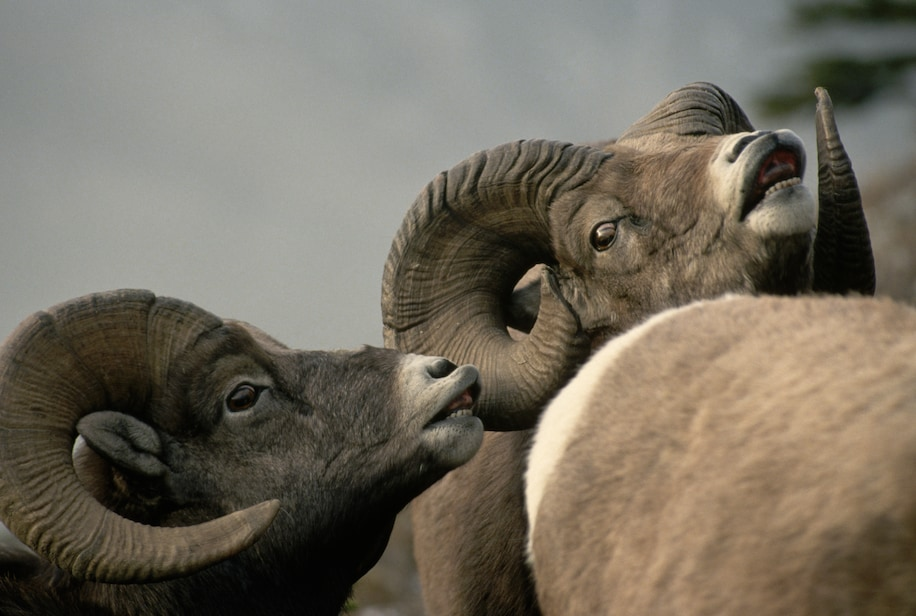
Male bighorn sheep. Mammalogist Valerius Geist noticed frequent homosexual sex at his bighorn sheep field site in the 1960s but avoided publishing those findings for years. (Joe McDonald/Getty Images/The Image Bank RF)
Like the Edinburgh penguins, many animals are sexually monomorphic, meaning males and females are indistinguishable to human eyes. This makes it all too easy to map our own assumptions onto their sex lives — and to tell ourselves a false story about which actions are “natural” and which are not.
As recently as 1986, a Georgia sodomy law was upheld in the landmark Bowers v. Hardwick case, and the “unnaturalness” of the act was a crucial part of the majority’s opinion. Sodomy laws stayed on the books until 2003, when the Supreme Court ruled them unconstitutional — aided by an amicus brief citing the research that had come out in the meantime documenting homosexual activity among animals.
We might have known about the sheer diversity of animal sexuality a long time ago if we, as a culture, had managed to lower our blinders. “We like to think we derive a lot of our ideas from the animal world, but it’s actually the opposite,” says Kota. “We put a lot of our ideas onto the animal world.” Now, we have begun to see a more complicated truth about animals — and also, perhaps, about ourselves.
Eliot Schrefer is the author of “Queer Ducks (and Other Animals): The Natural World of Animal Sexuality,” from which this article is adapted.
Perspective by Eliot Schrefer
June 30, 2022 at 8:55 a.m. EDT
In 1913, naturalists captured a flock of penguins from the Antarctic and brought them to spend the rest of their lives in the Edinburgh Zoo. The birds that survived the transition came to enchant the Scottish public with their antics. They could go from suave to goofy and back again, simply by gliding in the water, toddling around on land for a bit, then diving in once more.
Over the years, the zookeepers struggled to determine which penguins were male and which were female, renaming four of the five in the process. The complications only grew from there. Like most birds, penguins are socially but not sexually monogamous. Though they form lifelong unions, they are very happy to canoodle on the side — and there were only so many sexual configurations five of them could go through before one truth became self-evident: The penguins were bisexual. As zoo director T.H. Gillespie wryly observed in his 1932 recounting of these sexual triangulations, they “enjoy privileges not as yet permitted to civilized mankind.”
Bi penguins have been stirring things up for over a century. The first record of same-sex sex in penguins was in 1911, when explorer George Murray Levick discovered “depraved” behavior in wild Adélies. In 2000, a pair of male chinstrap penguins at New York City’s Central Park Zoo bonded and raised a chick from an egg they’d been given to foster, inspiring the children’s book “And Tango Makes Three.” More recently, penguin behavior sounded like it was ripped straight from a celebrity gossip site when it emerged that two male penguins had stolen an egg from a hetero couple at a Dutch zoo — and then proceeded to steal an egg from a “lesbian” couple the very next year.
Penguins aren’t the only sexually adventuresome animals. Over the past 20 years, a burst of research — driven in part by a new generation of scientists more accepting of queerness — has shown significant amounts of previously unreported homosexual behavior throughout the animal kingdom, from flour beetles to gorillas. While few animals are exclusively “gay” or “lesbian,” an extraordinary number, it appears, engage in some form of same-sex relations. There are now reputable evidence-confirmed findings of such behavior in 1,500 animal species and counting.
As a graduate student in animal studies, I’ve often faced an unpleasant prospect: The theory of natural selection, at least as it’s classically considered, could argue that queerness shouldn’t exist. In a Noah’s Ark conception of life, with dutifully procreating male-female pairs for each animal species, non-straight behavior seems to disrupt the natural order by preventing the transmission of genes over generations. This conundrum has started to feel far more than academic in recent months, as multiple states have passed legislation restricting reading about or even discussing LGBTQIA+ identities in schools. The logic behind such laws, it seems to me, goes something like this: If queerness doesn’t come about naturally, then it can be walled out of human populations by limiting access to the very idea of it.
The recent surge in same-sex animal scholarship, however, offers a powerful challenge to that thinking. For hundreds of years, it turns out, we’ve been looking at animal sex through too narrow a lens — with significant consequences for our beliefs about what counts as natural in our own species.
Christian theologians have long pointed to the absence of animal homosexuality as evidence that humans oughtn’t to be doing it, either. Thirteenth-century philosopher and priest Thomas Aquinas argued that homosexual behavior in humans is wrong precisely because it doesn’t occur between animals. He saw it as a sign of decadence — a falling down from our state of animal grace into the world of human corruption.
The assumption of heterosexuality among animals took its first major hit in 1834, when August Kelch, an entomologist, discovered two male Melolontha melolontha — beetles commonly known as cockchafers or doodlebugs — having sex. He concluded that it had to be an act of rape. As he initially framed it in a German scientific journal, “the larger and stronger of the two had forced itself on the smaller and weaker one, had exhausted it and only because of this dominance had conquered it.”
The puzzle of mating males captured the imagination of entomologists, who busily published articles about it for years. As science historian Ross Brooks chronicled in 2009 in the Archives of Natural History — in an article titled “All too human: responses to same-sex copulation in the common cockchafer” — some scientists proposed that the receiving males were being mistaken for females. Others offered still different explanations, but it wasn’t until 1896 that someone dared to put forward a radical suggestion: In a paper published even as Oscar Wilde sat in prison for “gross indecency,” Henri Gadeau de Kerville, a leading French entomologist, theorized that some of the doodlebugs just … preferred it (“pédérastie par goût”). He was thoroughly scolded by his colleagues — at which point the question of same-sex doodlebug sex, after having been bandied about for much of the 19th century, mostly dropped from scientific discourse.
Did scientists avoid publishing on same-sex animal sex because they were worried about being scolded as Gadeau de Kerville was? Or did they simply find it shameful? George Murray Levick, the explorer who wrote about homosexual behavior in Adélie penguins in 1911, shielded his observations of penguin “depravity” from casual observers by recording them in his field notes using the Greek alphabet — and they were still cut from the official expedition reports. A prominent mammalogist, Valerius Geist, couldn’t help but notice frequent homosexual sex at his bighorn sheep field site in the 1960s, but Geist avoided publishing those findings because it made him “cringe … to conceive of those magnificent beasts as ‘queers.’ ” Years later he relented, writing that he eventually “admitted that the rams lived in essentially a homosexual society.” As for those scientists who did want to write about same-sex sexual behavior in animals, one option was to couch it in the judgmental language used for humans — as in a 1922 study on baboons called “Disturbances of the Sexual Sense,” or a 1987 study of same-sex mating in butterflies titled “A Note on the Apparent Lowering of Moral Standards in the Lepidoptera.”
Research has shown that chimpanzees use sex for more than procreation; male chimps engage in sexual activity to reconcile after fights. (Fuse/Getty Images/Corbis RF Stills)
Up to a third of Laysan albatross nests are female-female. (Enrique Aguirre Aves/Getty Images/Photodisc)
The minimizing of animal sexual diversity was not only about discomfort. Christine Webb, a primatologist at Harvard’s Department of Human Evolutionary Biology, explains that the dominant model of evolution “emphasizes selfish competition and the survival of the fittest.” But the chimpanzees Webb studies use sex for a variety of purposes, such as managing stress and tension. Once she and the co-authors of her recent paper allowed for observations that contradicted their assumptions that chimps had sex for procreation only, they made a breakthrough discovery: Males engage in sexual activity to reconcile after fights.
A year later, a study of a separate group of chimps in Uganda found that “sociosexual behaviour” is common — and that the majority of it is between males.
This research is hardly an outlier. Coldblooded male garter snakes use pheromones to encourage courtship from other males in the area, forming “mating balls,” perhaps to help warm up individuals whose temperatures have gotten dangerously low. Polyamory — the bonding of three or more animals, instead of the conventional two — expands the numbers of parents for each offspring, increasing their survivability, and can be found in many species of waterfowl, most famously the graylag goose. Female-female pair bonds in birds such as gulls, roseate terns and albatrosses average more eggs (which are fertilized by sex outside the union) per nest. The fact that a bird population with many bonded females sharing a few males between them would have higher reproductive output led historian and ornithologist Jared Diamond to dryly wonder whether “further study of homosexually paired female birds may help clarify what, if anything, males are good for — in an evolutionary sense, of course.”
Evolutionary biologist Mounica Kota is a fan of Laysan albatrosses, for whom up to a third of the nests are female-female. “They’re like my lesbian moms. I have a big photograph of them in my office,” she told me. She’s part of the new generation of openly LGBTQIA+ scientists who are frank about how their personal identity aligns with their professional research, even if it opens them to accusations of partiality. Kota, who is a lesbian, struggled with coming out earlier in life, and she was heartened by a class in animal behavior that she took as an undergrad.
(Ælfleda Clackson for The Washington Post)
Sidney Woodruff, a PhD candidate in ecology at the University of California at Davis, has been studying conservation of the western pond turtle, which lacks sex chromosomes and whose sex is instead determined by incubation temperatures — a phenomenon turtle researchers dub “girls are hot, boys are cool.” Woodruff, who identifies as nonbinary and queer, feels kinship with animals who also cross sexual binaries — but they treat this personal element as a source of caution as much as anything else. “I have to keep in mind that if I’m researching sex and wildlife species, I’ll want it to be a certain way because of my own gender and sexual identity,” Woodruff told me. “It’s a lot of power that we have, but in our quest to find inaccuracies in previous research, we have to make sure we’re also being humble enough to know that we’re not always going to get the answer we want.”
Recently, scientists have begun to take seriously a theory that biologist Vincent Savolainen summarizes as “bisexual advantage”: the idea that fluid sexuality has increased reproduction chances over the history of life, making bisexuality “an evolutionary optimum.” In social animals, the logic goes, absolute homosexuality would produce no offspring, but absolute heterosexuality could also be limiting, as it might make for an organism that is “poor at forming social alliances.” Better for an animal to exist away from the extremes, so it won’t miss out on procreating or on the social survival strategies that same-sex activity offers. “The bisexual advantage model,” Savolainen concludes, “is perhaps the most conservative genetic explanation for the persistence of homosexual behavior.”
This model is supported by a 2019 paper from a group of young scholars that notes that the earliest creatures wouldn’t have discriminated between sexes, because the earliest creatures didn’t have sexes. Therefore, aversion to homosexual sex would have had to specifically arise over the history of life, which this team of researchers finds unlikely, since the opportunity cost of same-sex sex is relatively low. Given that sexual monogamy is more rare than we once thought, having occasional sex or even forming a lifelong bond with a same-sex partner doesn’t mean an animal isn’t also reproducing. As one of the originators of this “ancestral state” hypothesis, Max Lambert, put it to me: “Biologists told ourselves for so long that it must be unnatural. My research led to a good question: Why do queer things exist? The simple answer is that animal bisexuality is not costly. It was so biologically simple.”
As most any Homo sapiens will tell you, sex that doesn’t bring about offspring can still be worthwhile. The bonobo apes, for example, capitalize on the release of the bonding hormone oxytocin during homosexual sex to strengthen the social alliances between females. A study by primatologists Zanna Clay and Frans de Waal found that female-female sex is the most frequent sexual activity in the species — which is especially noteworthy, as bonobos also happen to be in a rough tie with chimpanzees as our closest animal relatives. Governed by a matriarchy of sexually connected mothers, they have far lower levels of aggression than chimps, giving them what Christine Webb described to me as “a reputation as the sexy hippie apes.”
Bottlenose dolphins also use sex to reinforce their social alliances, in their case between males. Outside of mother-calf bonds, unions between males are the only stable social unit in their society. Dolphin males will partner for life, and the pair will occasionally bring in a female to mate before going their own ways. It wasn’t until recent years that a prominent field site in Shark Bay, Australia, established just how those males cement their alliances: frequent and acrobatic sex, an average of 2.38 times an hour. (As one gay weekly newspaper joked, “Grindr has announced a new gay cruising app for dolphins, called Flippr.”)
In some marine snail species, all individuals are born male, and once two males choose each other, one of them simply changes sex. Much later, after she’s finished with her first partner, that now-female snail might meet a different male and stay female. In laboratory studies, some males kept choosing other males, even though they’d then have to wait a few days for their partner to change sex, while other males always went for females. The snails had preferences!
Webb argues that same-sex sexual behavior, as in her chimpanzee subjects, is an adaptive, desirable response to our needs as interconnected creatures. “What about cooperation?” she asks. “What about social bonding — which we know is really important for fitness, by the way, right? Social bonds are really important for well-being. Managing conflicts and managing stress and tension are really important for well-being. We’ve been fixated on one side of the story.”
Meanwhile, though members of some animal species gain advantages from same-sex behavior, research is also emerging to suggest that other species might do it just because it feels good. Within a scientific worldview that continues mostly to see animals as evolutionary cogs, this is a controversial take. Anthropologist Paul Vasey has been studying Japanese macaque monkeys for decades. Like bonobos, the macaques engage in frequent female-female sex. Vasey and his team methodically tested the various theories that have been proposed for the persistence of homosexual sex in the monkeys: that the females were expressing dominance; that they were bartering for parental care; that they were reconciling after a fight; or (my personal favorite) that they were staging sexual encounters to excite nearby males, in what I’d call the “you wish, guys” theory of monkey lesbianism. Vasey found that none of the theories held up to testing, which led him to a startling conclusion, at least to any strict Darwinians: “Despite over 40 years of intensive research on this species, there is not a single study demonstrating any adaptive value for female-female sexual behavior in Japanese macaques.” In other words, the females appear to be having sex with other females simply because they derive pleasure from it.
Male bighorn sheep. Mammalogist Valerius Geist noticed frequent homosexual sex at his bighorn sheep field site in the 1960s but avoided publishing those findings for years. (Joe McDonald/Getty Images/The Image Bank RF)
Like the Edinburgh penguins, many animals are sexually monomorphic, meaning males and females are indistinguishable to human eyes. This makes it all too easy to map our own assumptions onto their sex lives — and to tell ourselves a false story about which actions are “natural” and which are not.
As recently as 1986, a Georgia sodomy law was upheld in the landmark Bowers v. Hardwick case, and the “unnaturalness” of the act was a crucial part of the majority’s opinion. Sodomy laws stayed on the books until 2003, when the Supreme Court ruled them unconstitutional — aided by an amicus brief citing the research that had come out in the meantime documenting homosexual activity among animals.
We might have known about the sheer diversity of animal sexuality a long time ago if we, as a culture, had managed to lower our blinders. “We like to think we derive a lot of our ideas from the animal world, but it’s actually the opposite,” says Kota. “We put a lot of our ideas onto the animal world.” Now, we have begun to see a more complicated truth about animals — and also, perhaps, about ourselves.
Eliot Schrefer is the author of “Queer Ducks (and Other Animals): The Natural World of Animal Sexuality,” from which this article is adapted.


