Oh dear this thread has gone wild. Anyway here is my contribution (from The Critic in the UK):
Let’s begin with the clearest indicator of the extent to which a community is “marginalised and abused”: the murder rate of those within it. Because there is no stable definition of what constitutes a “trans person”, there is no standardised method for recording the deaths of trans people across the UK. However, we know that there have been
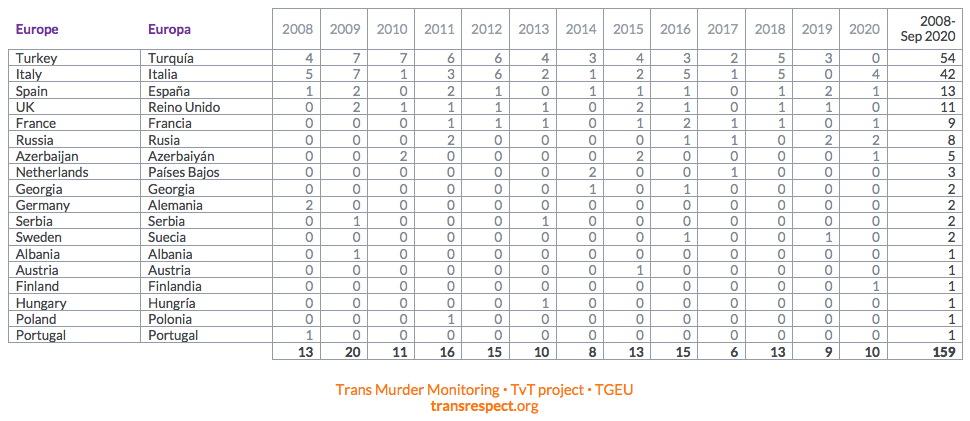
just eight reported murders of people who defined themselves as transgender, transsexual or cross-dressers in the UK since reporting began in 2008. Even trans organisation
Transrespect, which includes people who have
committed suicide and
people whose death was originally and erroneously treated as suspicious in their numbers for “murdered” victims,
says the number from 2008 to 2020 is eleven.
Note that the UK is not a European anomaly — in Germany there hasn’t been a murder of a trans person since 2008, while 26 countries in Europe have reported no murders of trans people for the entire period.
Even though we’ve seen a sharp rise in the number of people who identify as transgender in the last few years, a trans person hasn’t been murdered in the UK for
nearly three years and there are, for example, no reports
ever of a trans person in Scotland, Wales or Northern Ireland being murdered.
Moreover, not one of even the eleven people Transrespect says were murdered, were killed due to “transphobia”. The victim in each case was typically murdered by a male sexual partner due to drugs or money issues. None were killed by a woman — and one was killed by a
man who identifies as a woman.
According to this fact check,
the average adult in England and Wales has a one-in-100,000 chance of being murdered in a given year whereas
the average trans person has a one-in-200,000 to one-in-500,000 chance of being murdered in the UK over the course of a year (it is now almost certainly nearer the top end due to the murder rate dropping below one per year since then). It concludes that a trans person is less likely to be murdered than the average person.
In fact, a trans person is less likely to be murdered than just about any other accepted category or identity.
Perhaps we can look at the number of hate crimes committed against this vague category of person. Doing so also suggests the trans “community” is far from abused.
True, the total number of hate crime offences has soared in recent years. However, this has been driven by changes to both the recording of crimes and the identification of what constitutes a hate crime. Measures of hate crime that are unaffected by changes in policing or recording methods, such as the Crime Survey for England and Wales, show a “
long-term decline in hate crime”.
The hate crime rises that many politicians refer to when talking about the trans issue, is due to new College of Policing guidance that arrived in in 2014, which states that the “defining factor” in whether something is measured as a hate crime is “the perception of the victim, or any other person”. Many of these seem to be so subjective that they’re absurd,
such as someone beeping their horn at a fellow motorist —
who reported it to the police as a racist attack, and at least one force has admitted it has included, in its hate crime statistics, incidents in which no crime had actually taken place.
Another report revealed that police officers are victims of hate crime incidents in almost
half of all hate crime prosecutions. This presumably includes the young man with autism who made the mistake of asking a trans-identified female police officer, “Are you a boy or a girl?” He was convicted. Perhaps it’s time to retry the 2003 case of the teenager who asked a mounted policeman,
“Is your horse gay?”
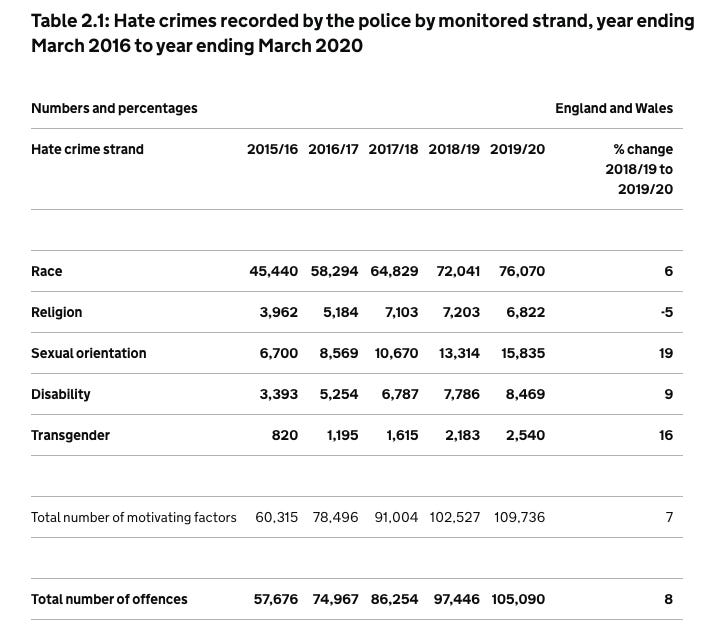
Despite all this nonsense, of the five monitored strands that the police record as hate crimes, the transgender category has, every year, and by some distance, seen the
least number of “hate crimes” against it. In fact, religion — the next-lowest — saw nearly three times as many incidents in the last recording year.
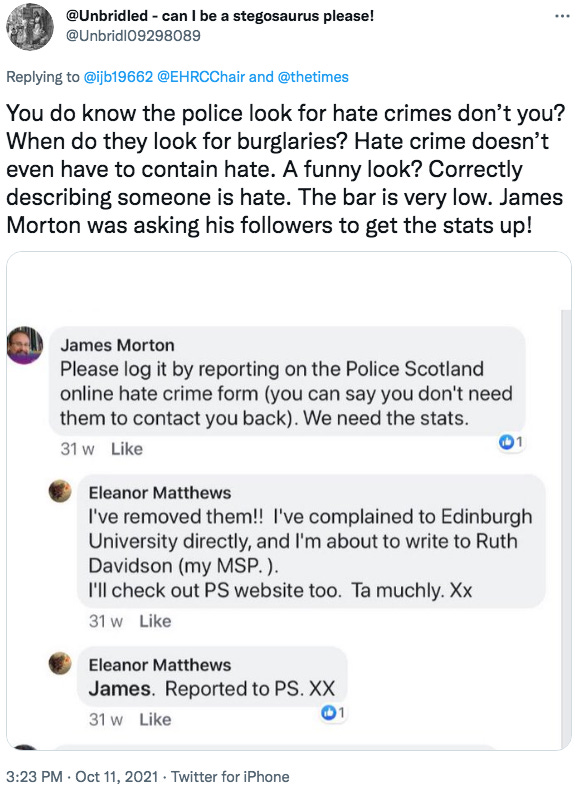
Trans rights activists are acutely aware of the lack of hate crime statistics to back up these repeated claims. Here, the Scottish Transgender Alliance Manager at the Equality Network, James Morton, asks a trans person to report their claim of victimhood to the police — for the simple reason that “
we need the stats”.
Another statistic that is commonly used to show trans vulnerability are suicide rates. In particular, one line often trotted out is that “41, or even 48, per cent of young transgender people have attempted suicide”.
The
41 per cent study’s authors have admitted their research was flawed, while the 48 per cent study comes from a survey by mental health charity PACE that has also been widely debunked. In fact, its sample size alone, of just
27 self-selected people, meant that the
Independent Press Standards Organisation (IPSO) issued a statement that journalists who repeat the statistic are misrepresenting the truth as it “highlights potential editorial standards issues relating [to] accuracy”.
The NHS’s Tavistock GIDS has suggested that suicidality amongst those who are referred to the service is “extremely rare” and a study by Professor Biggs found that children with autism, depression or anorexia are many times more likely to take their life than a child with gender identity issues. A US study in 2018 found that LGBT children experience a higher rate of suicides from the very low base of heterosexual boys, but the biggest issue was whether they were female or not: transgender, lesbian and bisexual females all saw a similar rate.
The motives of trans rights activists in convincing the general public that transgender people are the most vulnerable demographic, against all available evidence, are manifold.
Parents of unhappy or mentally unwell children who express questions about their gender identity will naturally take extreme measures and support flawed policies which they believe will prevent their child from taking his or her life.
Opportunists like Owen Hurcum and Morgane Oger can bamboozle the public into thinking that privileged white men are worthy of your sympathy and support.
Students can pretend that women like Kathleen Stock are monsters, thereby excusing their own monstrous behaviour as they harass and terrorise them.
As for politicians, it’s a bluff. An easy way of pretending they have a grasp of a stance
that not even its proponents understand. But its usefulness may be coming to an end, because even if journalists continue to let them get away with it, an increasingly better-informed public certainly will not.